

You watched a tour pro drain everything with a putter shaped like a tuning fork, and now half the models on the rack are labeled “zero torque.” I build zero-torque putters by hand, so I get asked about them constantly — usually some version of “are these real, or is it just marketing?”
Here’s the straight version from someone who actually mills the heads and sets the shafts. No hype, no brand loyalty to defend. Just what a zero-torque putter is, how it feels, and whether one belongs in your bag.

Signature Design · The Obsidian Grain
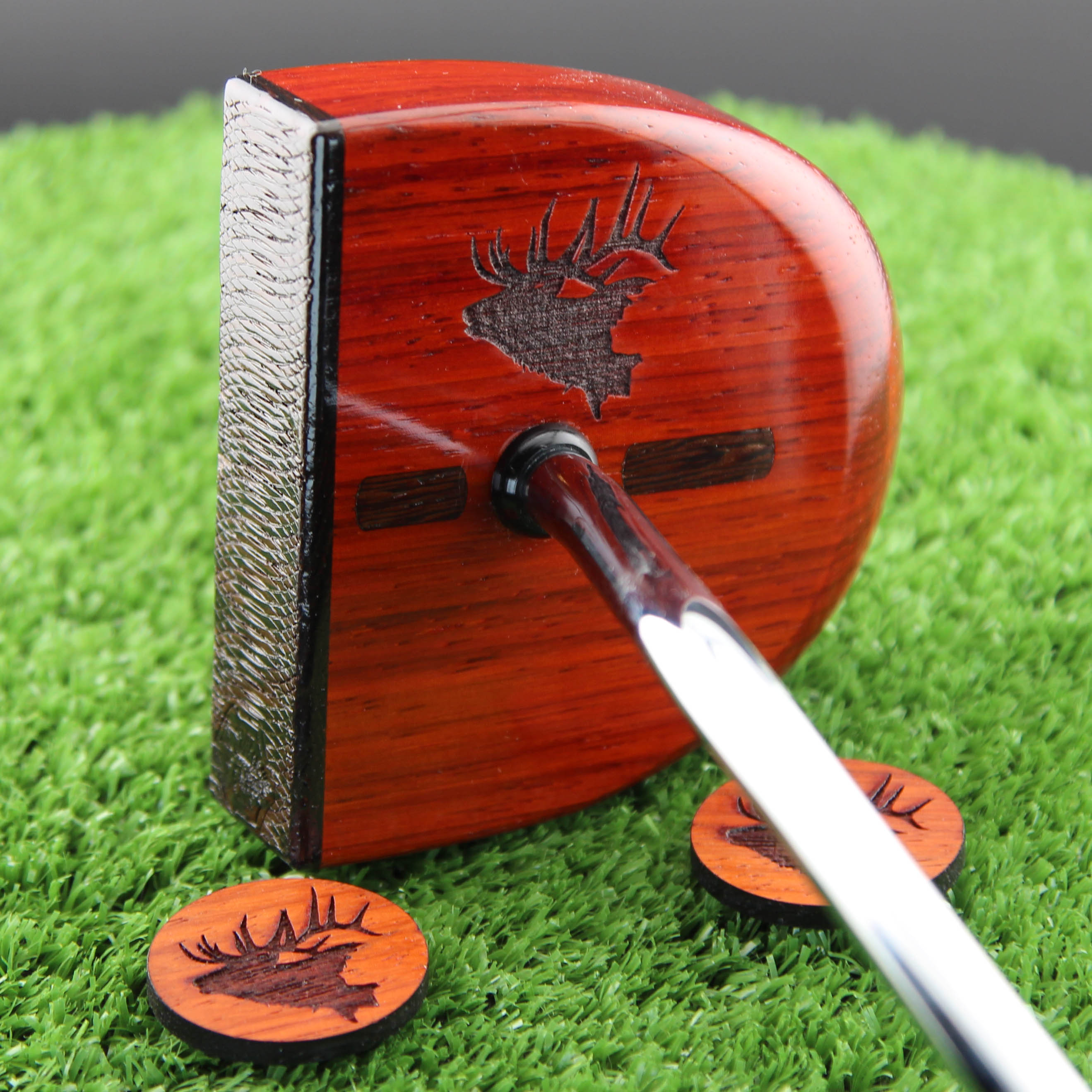
Obsidian Grain Zero-Torque Center-Shaft Putter
$310 — striped zebrawood on a set-back center shaft
CNC-machined to exact tolerances, hand-finished in the shop — and ready for your custom engraving on the top and sole (+$40 at checkout).
Design Yours → Add to CartWhat a zero-torque putter actually is
Torque is a twisting force. On a normal putter, the head’s center of gravity sits off to the side of the shaft axis, so when you swing, the head wants to rotate — the face opens going back and has to close coming through. You spend the whole stroke managing that twist, mostly without realizing it.
A zero-torque putter is built so the head’s center of gravity lines up with the shaft axis. With nothing pulling the head off-square, the face wants to stay pointed down your path through the stroke. Makers pull this off with non-traditional hosels and by setting the shaft back into the body of the head rather than at the front edge.
One honest caveat up front: a putter that wants to stay square doesn’t guarantee you make more putts. It removes one variable. You still have to read the green and roll it the right speed.
“Isn’t that just a center-shaft putter?”
This is the question I get most, and it’s a good one. The answer is no — and the difference is the whole point.
A traditional center-shaft putter has the shaft entering right at the leading edge of the head. That’s center-shaft, but the center of gravity still sits behind the shaft, so it still has torque. A zero-torque design moves the shaft back into the head so it runs through the center of gravity. Same general look at a glance, completely different behavior.
I build center-shaft zero-torque putters, and that set-back shaft placement is the part I sweat over. Get it right and the head balances on the line of the shaft; get it wrong and you’ve just made a good-looking center-shaft putter that still twists.
Zero torque vs. face balanced vs. toe hang
These three terms get thrown around as if they sit on the same scale. They don’t, and mixing them up is how golfers end up buying the wrong thing.
| Balance type | At rest | In motion | Best fit |
|---|---|---|---|
| Toe hang | Toe droops toward the ground | Head rotates open and closed with the stroke | A noticeable arc |
| Face balanced | Face points at the sky when you balance the shaft on a finger (Source: Fairway Jockey) | Square at rest, but doesn’t resist rotating once it’s moving | Straight-back, straight-through |
| Zero torque | Toe often points up, since the CG sits behind the face | Actively resists rotating throughout the stroke | Players who lose the face, arc or not |
The clean way to hold it in your head: face balanced describes a putter sitting still, and zero torque is a design objective for the putter in motion (Source: Fairway Jockey). A putter can be face balanced and still twist plenty once you swing it.
What changes when you have to build one
Here’s the part the equipment reviews skip. Putting the shaft axis through the center of gravity isn’t a hosel change — it’s a mass-distribution problem you solve before anything gets cut.
In CAD I’m pushing mass out to the far corners of the head for stability, then finding where that combined mass center actually lands, then routing the shaft to meet it. Move a wing, deepen a back pocket, swap a layer, and the balance point walks. Every one of those decisions loops back to the shaft line.
Layered exotic hardwood makes that harder and more interesting than working a single billet of steel. Wenge, Padauk, Rosewood and Canarywood all carry different densities, so the stack-up itself becomes a tuning tool — I can shift the balance point by changing which wood sits where, not just by hollowing mass out of a casting. Then the head gets CNC-machined to the tolerances the layout demands and hand-finished after.
It’s also why two builds that look similar can balance differently. The wood isn’t decoration sitting on top of the engineering — it’s part of it.
How a zero-torque putter feels
Feel is personal, but there’s a pattern. In motion, most zero-torque putters feel light — lighter than their actual head weight suggests — because that twisting force you’ve always sensed as “head weight” is mostly gone. With less feedback in the hands, a lot of golfers naturally lighten their grip and let the shoulders run the stroke instead of steering with the wrists. Some players love that calm; others say it feels a little empty at first and takes a few rounds to trust.
That feedback question is exactly where the head itself matters. A dense, milled exotic-hardwood head carries its mass differently than a light cast head, and it gives the ball a softer, more connected sound at impact. It’s why my center-shaft zero-torque Woodrich builds — like the Padauk-and-Wenge and Padauk-and-Canarywood models in the Zero Torque Center Shaft collection — pair the set-back shaft with a solid hardwood head: you keep the square-face behavior, but the putter still talks back to your hands.
Who a zero-torque putter is for (and who it isn’t)
A zero-torque putter tends to help the golfer with a straighter, shoulder-driven stroke, anyone who fights the face rotating shut or open, and players who pull and push putts they thought they’d lined up perfectly. If you want a quieter visual and less to manage, it’s worth a real look.
It’s a tougher sell if you have a strong arc and love the toe-hang feedback of a classic blade, or if you simply trust a putter you’ve manipulated for twenty years. Even then, less twisting means less to correct — so don’t rule it out on stroke type alone. Just go in clear-eyed: a zero-torque putter is a tool, not a cure (Source: Plugged In Golf). Expect a honeymoon week, then the real work of dialing in speed.
From the Shop
Pick Your Putter — Every One Can Be Engraved


Add custom engraving to any putter for $40 — just select the option on the product page.
Frequently asked questions
Do zero-torque putters actually work?
They can genuinely reduce face rotation and make the face easier to return square, which helps golfers who fight pulls and pushes. They are not automatic, though — you still have to match the putter to your stroke and put in the reps to own your speed. They also have a different feel that can take some time to get used to.
Is a center-shaft putter the same as a zero-torque putter?
No. A traditional center-shaft putter has the shaft at the leading edge and still has torque. A zero-torque putter sets the shaft back so it runs through the head’s center of gravity. You can build a center-shaft putter that is zero-torque, but the two terms are not interchangeable.
Are zero-torque putters good for an arc stroke?
They’re most often recommended for straighter strokes, but arc putters can benefit too — less built-in twist means less manipulation needed to square the face. The bigger factors are whether you like the calmer feel and can adjust to the lighter feedback.
What’s the difference between zero-torque and face-balanced?
Face-balanced describes how a putter sits (the face points up when you balance the shaft on your finger). Zero-torque is a design goal — engineering the center of gravity onto the shaft axis so the head resists rotating at all. Zero-torque is the stronger, more deliberate version of keeping the face quiet.
Can a wood putter be zero torque?
Yes, and the layered construction actually helps. Because different hardwoods carry different densities, the wood stack itself can be arranged to place the center of gravity where the shaft needs to meet it, rather than machining mass out of a single block.
So, should you build one into your bag?
If your misses are pulls and pushes, your stroke is more straight-back-straight-through than sweeping, and the idea of fighting your putter less sounds good — a zero-torque putter is worth real time on the practice green. If you’re a committed arc player who loves the feedback of a toe-hung blade, you’ll probably keep what you have, and that’s a fine answer too.
If you do want to try one, I’d love to build you something that performs like the tour models but feels like nothing else on the green. Take a look at the Zero Torque Center Shaft collection, or reach out and we’ll spec a custom hardwood build around your stroke.
Make Your Mark on the Green
Every TimberTouch putter is designed in CAD, CNC-machined to exact tolerances, and hand-finished. Pick yours and we'll engrave your story into it.
Shop All Putters →First Look at New One-of-a-Kind Builds
Many of our putters are one of a kind — when they're gone, they're gone. Join the list and see new builds and engraving ideas before anyone else.
Share:
Mallet vs. Blade Putter: Which Suits Your Stroke?
Left-Handed Putters: Why Lefties Deserve More Than an Afterthought