

If you play golf left-handed, you already know the drill. You find a putter you love online, you get excited, and then you read the fine print: right-hand only. Left-handed putters exist, but the good ones are scarce, the wait is long, and too many of them are just a right-handed head flipped over and hoped for the best. As a maker who builds every putter by hand, I think that's a shame, because a lefty deserves the same feel, balance, and roll as anyone else.

Signature Design · The Highmark
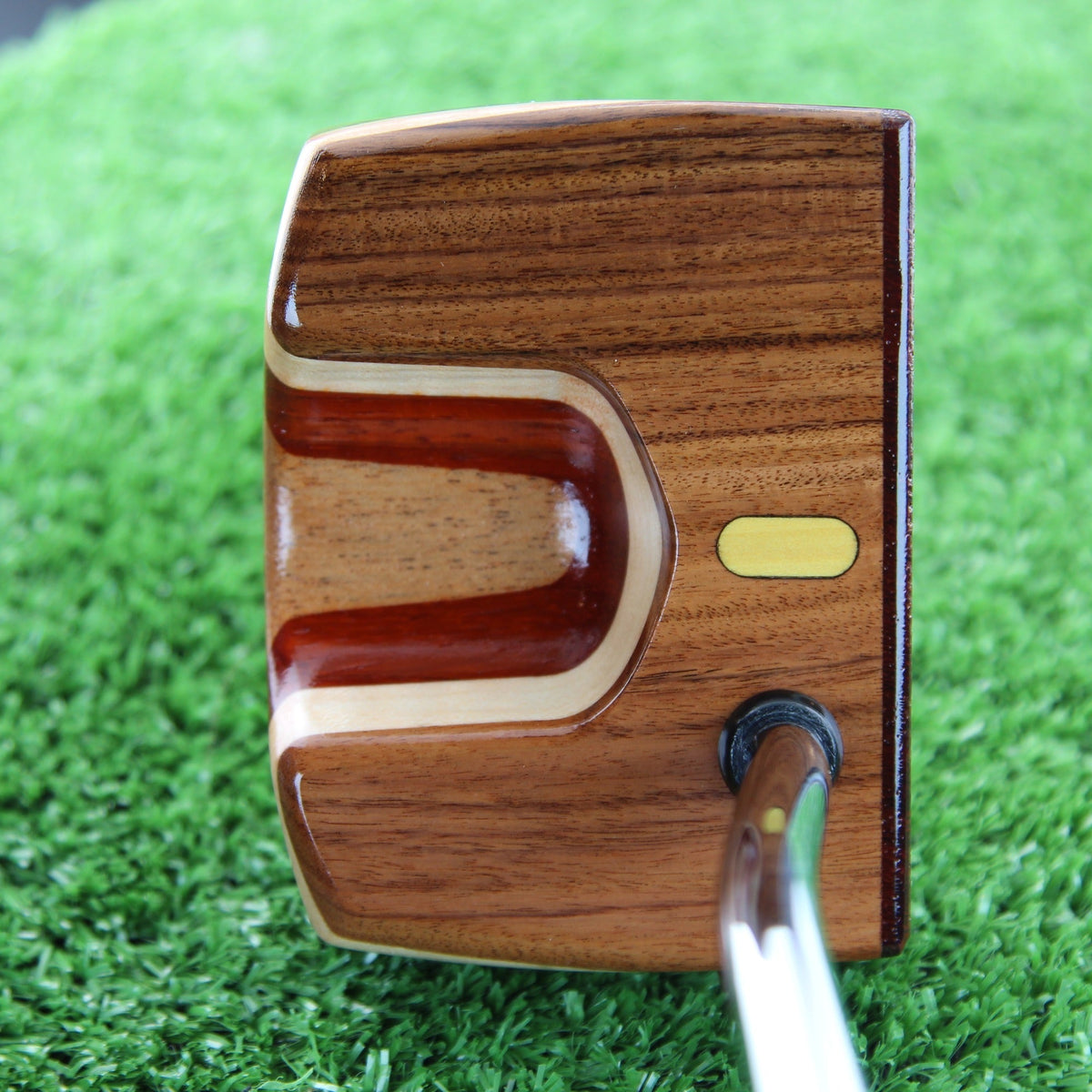
Highmark — Canarywood & Walnut Woodrich Regal
$299 — golden Canarywood over Walnut with a Padauk face
CNC-machined to exact tolerances, hand-finished in the shop — and ready for your custom engraving on the top and sole (+$40 at checkout).
Design Yours → Add to CartI build left-handed putters the same way I build right-handed ones: one at a time, from layered exotic hardwood, weighted and balanced for the person swinging it. This is a straight look at why lefty options are so thin, what actually changes when a putter is built for the left side, and how to find one that fits you instead of settling.
Why left-handed putters are so hard to find
The short answer is math. Left-handed golfers make up an estimated 10 to 12 percent of the golf-playing population (Source: GolfPass), so the big factories chase the other 90 percent and treat lefties as a rounding error.
It shows up in the lineups. In one recent Scotty Cameron Super Select run of ten models, just four were offered to left-handers (Source: GolfPass). If you want a specific head, a specific length, and a specific finish as a lefty, you're often told to wait on a custom order from the factory, or you simply can't get it at all.
The good news is the gap is closing. Over 65 percent of major putter models now offer a left-handed version, up from about 45 percent in 2021 (Source: Master of the Greens). That's real progress. But "available" and "built with care for a lefty" are two very different things.
You can't just flip a right-handed putter
Here's the part most golfers don't realize. A putter isn't symmetrical. The face angle, the shaft offset, and the toe hang are all built to work in one direction. Turn a right-handed putter around and address it from the left and none of those things sit the way they should.
Toe hang is the clearest example. It describes how the head hangs when you balance the shaft, and it's tuned to match a stroke that arcs a certain way. Reverse the club and that arc flips, so a head designed to help a right-hander square up now fights a left-hander instead of helping.
Offset behaves the same way. On a proper left-handed build, the hosel and the lean of the shaft are mirrored, so your hands sit ahead of the ball the way they're supposed to and the face returns square. A flipped right-handed head can't give you that. It's not a small detail either, because putting is the one place in the bag where a millimeter of face angle turns into a missed cup.
How I build left-handed putters at TimberTouch
When a lefty orders from me, nothing about the process is a downgrade. I mirror the geometry for real: the hosel, the offset, and the balance are all built for the left side from the start, not adapted after the fact. The head is layered from exotic woods like Padauk, Wenge, Rosewood, Zebrawood, and Bubinga, then weighted far outside for high MOI and a forgiving, stable roll.
That's the whole point of building by hand. My left-handed putters aren't a separate, lesser line. They're the same one-of-a-kind builds, in the same woods, at the same quality, just mirrored for the way you stand over the ball. A recent one is a lefty Woodrich Regal mid-mallet in Rosewood, Padauk, and Mahogany, with the back cavity that gives that model its stability. A left-handed golfer should be choosing a putter for its feel and its grain, not settling for whatever happens to exist.
Should you even putt left-handed?
This one surprises people. Being left-handed for full swings doesn't automatically mean you should putt left-handed. Putting is driven by your dominant hand and how squarely it can roll the ball, and plenty of golfers put a better roll on it from the opposite side.
The most famous example runs the other way. Phil Mickelson plays and putts left-handed, but he controls the putter face with his right hand because that's actually his dominant hand (Source: RotarySwing). The lesson isn't "switch sides." It's that you should test which hand rolls the ball straighter before you commit to a putter, because that decision determines everything else about the build.
If you roll it best from the left, then a true left-handed putter is worth getting right. If you're genuinely on the fence, that's exactly the kind of thing to sort out before you order, and it's a conversation I'm always happy to have.
Choosing left-handed putters that actually fit
Once you know you're putting from the left, fit comes down to a few honest questions. Get these right and the putter disappears in your hands, which is the whole idea.
Length. Stand in your real putting posture and let your arms hang. A putter that's too long forces you to stand up and cuts across the ball. Most golfers land between 33 and 35 inches, but your posture decides, not a chart.
Head style. A larger mallet with far-outside weighting is more stable and more forgiving on off-center hits, which helps most golfers. A smaller blade rewards a more precise stroke and gives a different kind of feedback. Neither is wrong; they just suit different strokes.
Feel. This is where wood earns its place. A hardwood face gives a softer, quieter, more organic contact than a hard metal insert, and it feeds back through your hands so you learn distance faster. For a lot of lefties who've only ever putted with whatever was on the rack, that feel is the thing they didn't know they were missing.
From the Shop
Pick Your Putter — Every One Can Be Engraved


Add custom engraving to any putter for $40 — just select the option on the product page.
Frequently asked questions about left-handed putters
Can a left-handed golfer use a right-handed putter?
You physically can, and some golfers do putt with their non-dominant side. But a right-handed putter reversed gives a lefty the wrong offset and toe hang, so the face won't return square as easily. If you putt from the left, a putter built left-handed will always give you a truer setup.
Why are there so few left-handed putters?
Lefties are only about 10 to 12 percent of golfers, so mass manufacturers build fewer left-handed models to chase the larger right-handed market (Source: GolfPass). A hand builder doesn't have that constraint, which is why custom shops can offer lefties the same range as righties.
Are left-handed putters more expensive?
From a big brand they often carry longer waits or limited runs, but not always a higher price. From my shop the price is the same either way, because the work of building a left-handed putter is the same as a right-handed one.
How do I know if I should putt left-handed?
Test both sides on a practice green and see which hand rolls the ball straighter and more repeatably. Your full-swing side isn't the deciding factor; your dominant hand and your best roll are.
Can you build a left-handed putter in any wood?
Yes. Every wood and every style I offer can be built left-handed, from a Woodrich Regal mid-mallet to a large Fatty mallet, in Padauk, Wenge, Zebrawood, and more.
The bottom line for left-handed golfers
You shouldn't have to accept less putter because of the hand you swing with. The scarcity of good left-handed putters is a manufacturing decision, not a rule of the game, and a putter built for the left side from the start will always beat a right-handed club turned around. Figure out which hand rolls the ball best, get the length and head style to match your stroke, and then choose a putter you actually want to look at over every putt.
If you're a lefty who's tired of settling, take a look at the left-handed putters I build, or reach out and we'll spec a custom one to fit you. Same woods, same craftsmanship, same care, mirrored for your side.
Make Your Mark on the Green
Every TimberTouch putter is designed in CAD, CNC-machined to exact tolerances, and hand-finished. Pick yours and we'll engrave your story into it.
Shop All Putters →First Look at New One-of-a-Kind Builds
Many of our putters are one of a kind — when they're gone, they're gone. Join the list and see new builds and engraving ideas before anyone else.
Share:
What Is a Zero-Torque Putter? A Putter Maker's Honest Take
Oversized Mallet Putter: Why Bigger Means More Forgiveness