

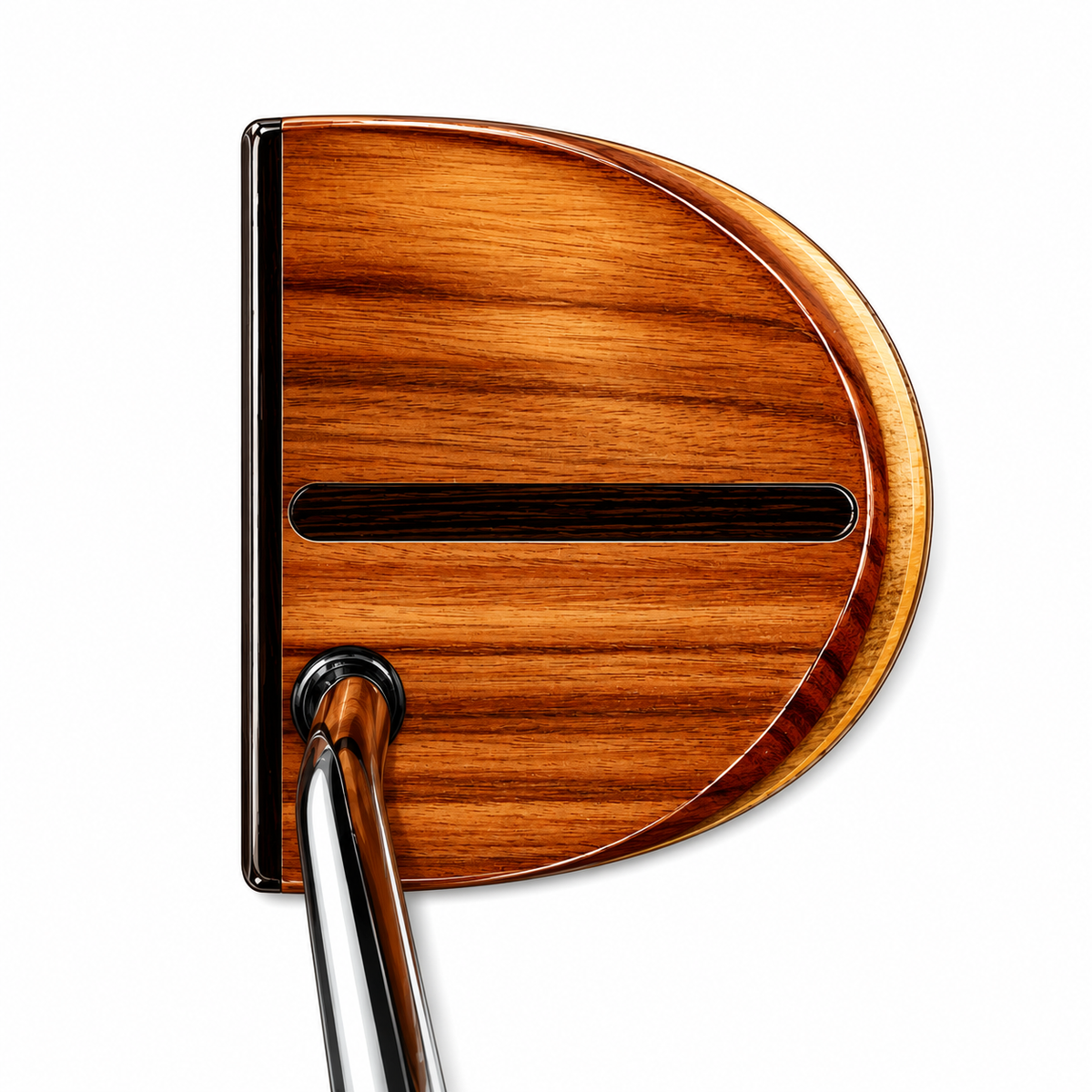
Stand over a six-footer with a small blade and the head feels nervous in your hands. Stand over the same putt with a big, broad mallet and something settles. That steadiness is the whole point of an oversized mallet putter, and it is not just a feeling. A larger head pushes weight to the far corners, which makes the putter resist twisting when you catch the ball a groove off center. The result is a putt that holds its line and its pace even when your stroke is a hair less than perfect.

Signature Design · The Wild Side FATTY
Wild Side FATTY — Canarywood Zero-Torque Mallet
$310 — wild Canarywood grain on a big, forgiving head
CNC-machined to exact tolerances, hand-finished in the shop — and ready for your custom engraving on the top and sole (+$40 at checkout).
Design Yours → Add to CartI build these heads by hand from layered exotic hardwoods, so I spend a lot of time thinking about where mass sits and how a head behaves through impact. Here is what an oversized mallet actually does for your putting, who it suits, and how to pick one that fits the way you stroke the ball.
What Makes a Putter an Oversized Mallet
A mallet putter is any head with a larger, deeper footprint than a traditional blade. An oversized mallet takes that further: a wide body, plenty of depth from face to back, and mass positioned out toward the perimeter rather than clustered behind the face.
That shape does two useful things. It gives you a broad, calm surface to aim, usually with a sight line or two running front to back. And it lets the maker park weight far from the center of the face, which is where forgiveness comes from.
Blades put the mass close to the sweet spot, so they reward a precise strike and punish a poor one. An oversized mallet spreads the mass out. On a miss, there is simply more head fighting to stay square. You feel that as a putt that behaves rather than one that squirts.
Why a Bigger Head Means More Forgiveness
The engineering term is MOI, or moment of inertia. It is a measure of how much a head resists twisting. Push the weight outward and MOI climbs, so the face stays squarer through an off-center hit.
Forgiving mallets can carry roughly twice the MOI of a good blade, which is why an off-center strike loses far less pace and rolls closer to your intended line (Source: Today's Golfer). That is the difference between a mishit that dies two feet short and one that finishes stone dead.
The gap shows up on the scorecard too. In independent lab testing, mallet users have holed a noticeably higher share of their short putts than blade users on the same strokes (Source: MyGolfSpy). You do not have to putt better to see it. The head is doing more of the work.
Weight matters as much as width. A heavier head, hung out to the perimeter, is harder to knock off track and tends to swing on a smoother tempo. That is one reason I build my oversized heads with real heft rather than shaving them down to look dainty.
How an Oversized Mallet Feels on the Green
Numbers explain the forgiveness, but feel is what keeps a putter in the bag. This is where the material matters, and where a wood head parts ways with a milled slab of aluminum or steel.
Exotic hardwoods like Padauk, Wenge, Rosewood, and Zebrawood give a putt a softer, rounder sound at impact. The ball comes off with a warm knock instead of a metallic click, and that sound tells you a lot about how flush you struck it. Golfers describe it as more feedback and less harshness, especially on fast greens where a hot metal face can feel jumpy.
A layered wood body also lets me tune the balance in a way a single block cannot. Denser woods out at the flanks, lighter woods through the core, and the mass ends up exactly where it earns its keep. You get the calm, planted feel of a big mallet without the dead, clacky impact that turns some players off metal ones.
If you want to see how that plays out across different builds, my FATTY style putters are my take on the oversized mallet. Each one is a large, center-shaft-friendly head layered from exotic woods, built with the weight thrown far outside for stability and finished so no two are quite alike. They are the putters I reach for when a golfer tells me they want maximum forgiveness without giving up feel.
Who Should Play an Oversized Mallet Putter
An oversized mallet is not for everyone, and I would rather you love the putter than just admire it. The design suits some strokes far better than others.
It fits you well if your putting stroke runs fairly straight back and straight through. A large, face-balanced mallet wants to move on that path, and it rewards it with a square face and extra forgiveness (Source: TaylorMade). If you struggle with alignment or your short putts wander, the broad head and sight lines make it much easier to set up the same way every time.
High-handicap and mid-handicap players tend to gain the most, simply because they miss the center more often and the high MOI covers those misses. Golfers who lose confidence over four-footers often find that a steadier head quiets the hands.
Where I would steer you elsewhere: if you have a strong arcing stroke that swings the face open and shut, a blade or a lighter mallet may let that motion breathe. An oversized mallet can feel like it fights an aggressive arc. Fit the tool to your stroke, not the other way around.
From the Shop
Pick Your Putter — Every One Can Be Engraved


Add custom engraving to any putter for $40 — just select the option on the product page.
How to Choose an Oversized Mallet Putter
Once you have decided a big mallet suits your stroke, a few fitting details make the difference between a putter you tolerate and one you trust.
Length. Most golfers play a putter that is too long, which pushes the hands up and the eyes inside the ball. A putter fit to your posture lets your eyes sit over or just inside the line, which makes the big head easy to aim. Standard lengths run 33 to 35 inches, but the right number is the one that matches how you actually stand.
Weight and balance. Oversized mallets are usually face-balanced, meaning the face points skyward when you balance the shaft on a finger. That pairs naturally with a straight stroke. Match the head weight to your greens: heavier heads suit slower greens and jittery hands, lighter ones suit slick, fast surfaces.
Alignment aid. Pick the sight line that your eye trusts. Some players want a single center line, others want two rails framing the ball. On a wood head, I can set that line to read cleanly against the grain rather than fighting it.
Feel and material. This is the one most fitting charts ignore. Roll a few putts and listen. A face that gives you honest feedback will teach you distance control faster than any gadget, and it is the reason I keep building faces from wood.
Frequently Asked Questions
Is an oversized mallet putter more forgiving than a blade?
Yes. An oversized mallet places weight out toward the perimeter, which raises MOI and keeps the face squarer on off-center hits. Forgiving mallets can carry around twice the MOI of a blade, so mishits lose less speed and hold their line better (Source: Today's Golfer). For most golfers, that means more short putts that find the bottom of the cup.
Who should not use an oversized mallet putter?
Players with a strong arcing stroke that swings the face open and closed often prefer a blade or a lighter, toe-weighted mallet, because a big face-balanced head can resist that natural rotation. If your stroke arcs hard, fit the putter to that motion instead.
Are oversized mallet putters legal?
Yes. As long as the head meets the size and shape limits in the Rules of Golf and the face is not springlike, an oversized mallet conforms. My wood putters are built to those specs, so you can put one in play in any round.
Does a wood mallet feel different from a metal one?
It does. A layered exotic-wood head gives a softer, rounder sound and a warmer feel at impact than milled aluminum or steel, which many golfers read as clearer feedback, especially on fast greens. The forgiveness comes from the shape and weighting, while the wood shapes the feel.
What length should my mallet putter be?
Fit it to your posture rather than a number. Most golfers are best somewhere between 33 and 35 inches, set so your eyes sit over or just inside the target line and your hands hang naturally under your shoulders.
Finding the Right Big Mallet for Your Stroke
An oversized mallet putter earns its place by being steady when you are not. If your stroke runs fairly straight and you want your misses to behave, the high MOI of a big head is one of the simplest ways to hole more short putts without rebuilding your technique.
The part the spec sheets miss is feel, and that is where a hand-built wood head has something a factory mallet does not. If that sounds like your kind of putter, look through the builds, find a wood pairing that speaks to you, and I am glad to help you dial in the length and weight so it fits your stroke from the first roll.
Make Your Mark on the Green
Every TimberTouch putter is designed in CAD, CNC-machined to exact tolerances, and hand-finished. Pick yours and we'll engrave your story into it.
Shop All Putters →First Look at New One-of-a-Kind Builds
Many of our putters are one of a kind — when they're gone, they're gone. Join the list and see new builds and engraving ideas before anyone else.
Share:
Left-Handed Putters: Why Lefties Deserve More Than an Afterthought
What Length Putter Do I Need? A Putter Maker's Fitting Guide