

Most golfers never think about putter length until they've three-putted one too many greens and start blaming their stroke. Nine times out of ten in my shop, the stroke isn't the real problem — the fit is. Putter length quietly decides where your eyes sit, how your arms hang, and whether the face comes back square. Get it wrong and you fight your setup on every green. Get it right and the ball tends to go where you're looking.

Signature Design · The Plumbline
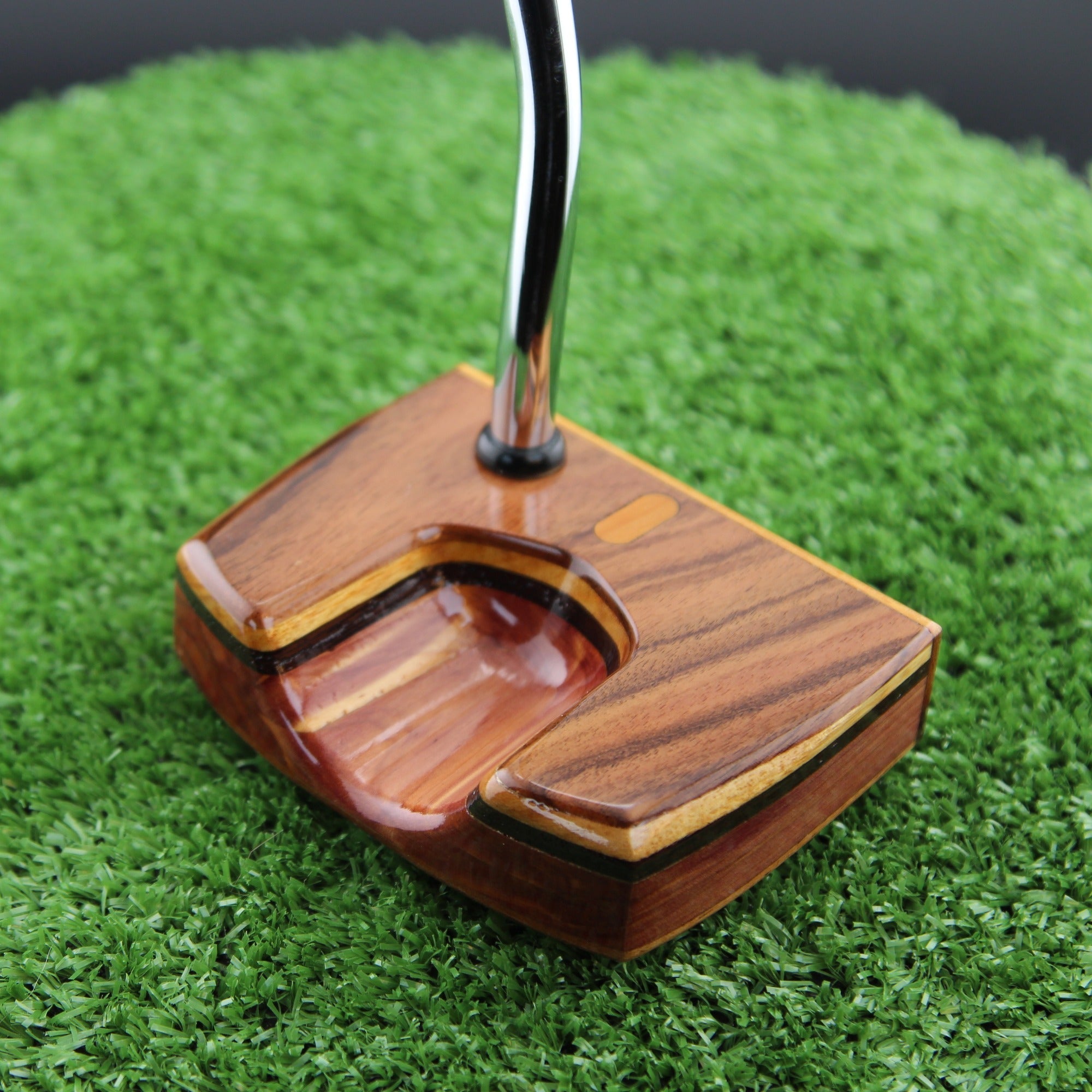
Plumbline — Purpleheart & Walnut FATTY Mallet
$305 — violet Purpleheart against steady Walnut
CNC-machined to exact tolerances, hand-finished in the shop — and ready for your custom engraving on the top and sole (+$40 at checkout).
Design Yours → Add to CartI build every putter to order, which means I set length before the head is ever finished. That's a different way of thinking about it than grabbing a 35-inch putter off a rack. Here's how I'd help you find the right putter length, honestly and without the sales pitch.
Why Putter Length Matters More Than You Think
Length is the fitting variable golfers ignore most and feel most. It controls three things at once.
Eye position. Putting coaches teach setting your eyes directly over the ball or just inside the target line. A putter that's too long pushes you upright and moves your eyes inside the line, so you aim left of where you think. Too short and you hunch over the top, pulling your eyes outside the ball.
Arm hang. Your arms should hang relaxed under your shoulders with a soft bend in the elbows. The wrong length forces you to reach out or tuck in, and tension in the hands is the enemy of a repeating stroke.
Face control. When length matches your posture, the putter sits flat on its sole and the face returns square on its own. Fight the length and you'll manipulate the face to compensate — usually without knowing it.
Putter Length by Height: A Starting Point, Not an Answer
Standard putters run from about 33 to 35 inches, with 35 inches often sold as the default. Most fitting charts map length to height, and a common version looks like this:
| Your height | Suggested putter length |
|---|---|
| 5'0" – 5'2" | 32.5" |
| 5'2" – 5'4" | 33" |
| 5'4" – 5'6" | 33.5" |
| 5'6" – 5'8" | 34" |
| 5'8" – 6'0" | 34.5" |
| 6'0" – 6'2" | 35" |
| 6'2" and up | 35"+ |
Use it as a rough starting point and nothing more. Height alone doesn't decide your putter length — arm length and posture matter just as much. Two golfers who both stand 5'10" can need different putters if one has long arms and a tall stance and the other bends low over the ball. The chart gets you in the neighborhood; your body finds the door.
How to Measure Your Putter Length at Home
You don't need a fitting studio to get close. You need golf shoes, a mirror or a friend, and five minutes.
1. The posture method (my favorite). Set up in your real putting stance with your eyes over the ball and your arms hanging naturally. Have someone measure from the crease where your palm meets your wrist straight down to the ground. That palm-to-ground number is your putter length, because it captures how you actually stand — not just how tall you are.
2. The wrist-to-floor check. Stand up straight, shoes on, arms relaxed at your sides. Measure from your wrist crease to the floor. It's a quick cross-check against the posture method — if the two disagree wildly, your stance is probably doing something the chart can't see.
3. The eyes-over-ball test. Get into your stance and drop a second ball from the bridge of your nose. If it lands on top of the ball you're putting, your length and posture are working together. If it lands well inside or outside the line, the length is fighting you.
Professional fittings run around $100 and are worth it if you're serious (Source: PGA Tour Superstore) — but these three checks will tell you most of what you need to know before you ever spend a dollar.
Standard Putters Get Cut Down. Custom Putters Get Built to You.
Here's the part the big brands don't advertise. When you buy a mass-produced putter in a length that isn't quite right, the fix is to cut the shaft down. That works, but it isn't free — shortening a shaft removes weight from the top of the club and changes the swingweight, so the head can start to feel heavier and less balanced than the maker intended.
Building to length avoids that trade entirely. In my shop, every putter is made to order, so I set your length first and then balance the head around it. A TimberTouch putter — whether it's a Woodrich Regal mid-mallet or a heftier FATTY — leaves the bench weighted for the length you actually play, not cut down from a one-size guess. If you want a build dialed to your measurements, that's exactly what my custom putters are for.
Signs Your Putter Is the Wrong Length
You don't always need a tape measure to know something's off. Watch for these:
- You consistently push or pull putts even though your stroke feels fine.
- You feel like you're reaching for the ball, or crowding it and standing too tall.
- The toe or heel of the putter sits up off the ground at address instead of flat.
- Your hands feel tense, or you fidget with your grip position before every putt.
- Your eyes clearly sit inside or outside the ball when you check in a mirror.
One or two of these can be coincidence. Three or more usually means your length is working against you.
From the Shop
Pick Your Putter — Every One Can Be Engraved


Add custom engraving to any putter for $40 — just select the option on the product page.
Putter Length FAQ
What length putter do I need for my height?
As a starting point, most golfers between 5'6" and 6'0" fit a 34" to 34.5" putter, while shorter players trend toward 33" and taller players toward 35" (Source: PGA Tour Superstore). But height is only the first clue — confirm it with the posture and eyes-over-ball tests, since arm length and how low you bend over the ball can move you a half-inch either way.
How do I measure putter length at home?
Set up in your putting stance with golf shoes on and have someone measure from the crease of your wrist straight down to the ground. That palm-to-ground measurement reflects your real posture better than a height chart does.
Is a longer or shorter putter better?
Neither is universally better — the best length is the one that puts your eyes over the ball with your arms hanging relaxed. Longer putters suit a more upright stance; shorter putters suit golfers who bend lower over the ball.
What is the standard putter length?
Retail putters usually come in 33", 34", and 35", with 35" often listed as the default (Source: PGA Tour Superstore). Standard doesn't mean correct, though — plenty of golfers play a stock 35" that's an inch too long for their setup.
Can you cut down a putter to change its length?
Yes, and it's common, but shortening the shaft removes weight from the top of the club and changes how the head feels. Building a putter to your length from the start preserves the intended head balance.
Finding Your Fit
The right putter length isn't about your height on a chart — it's about your eyes sitting over the ball, your arms hanging easy, and the face returning square without you thinking about it. Run the three home tests, watch for the warning signs, and you'll know within a half-inch what you should be playing.
When you're ready for a putter built to that number instead of cut down to it, I'd be glad to help. Tell me your measurements and the wood you're drawn to, and I'll build one to fit your stroke — start with the custom putters collection or reach out and we'll figure out your length together.
Make Your Mark on the Green
Every TimberTouch putter is designed in CAD, CNC-machined to exact tolerances, and hand-finished. Pick yours and we'll engrave your story into it.
Shop All Putters →First Look at New One-of-a-Kind Builds
Many of our putters are one of a kind — when they're gone, they're gone. Join the list and see new builds and engraving ideas before anyone else.
Share:
Oversized Mallet Putter: Why Bigger Means More Forgiveness
Reading Grain: How Bermuda, Bentgrass, and Poa Change Your Putts