

Walk into any putting fitting and the first question that matters isn't your handicap or your budget. It's how the head moves when you make a stroke. The mallet vs blade putter debate gets argued like there's one right answer, but after building both shapes by hand in my shop, I can tell you the better putter is simply the one that matches the way your hands already want to swing.
Here's how the two shapes actually differ, what the tracking data says, and a thirty-second test you can do at home to point yourself in the right direction.

Signature Design · The Plumbline
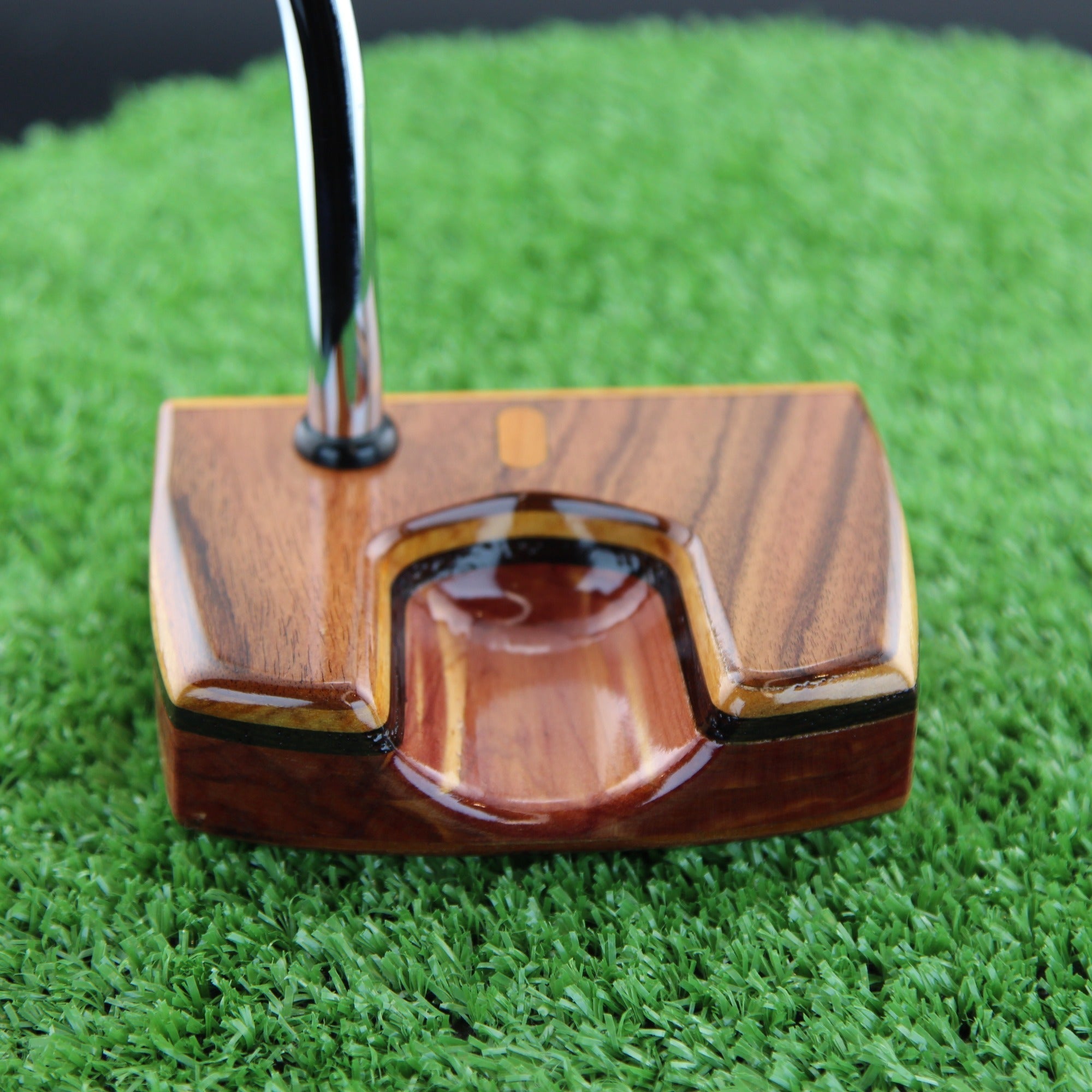
Plumbline FATTY Mallet Putter
$305 — purpleheart and walnut with the mass pushed far back and wide
CNC-machined to exact tolerances, hand-finished in the shop — and ready for your custom engraving on the top and sole (+$40 at checkout).
Design Yours → Add to CartMallet vs. Blade Putter: The Core Difference
A blade is the classic, compact shape — a slim head with most of its mass near the heel and toe of a small footprint. A mallet is larger and deeper, pushing weight back and out toward the perimeter and well behind the face.
That single design choice — where the weight sits — drives everything else. Pull the mass back and wide and you raise the head's resistance to twisting (its MOI), which buys forgiveness. Keep the head small and the mass close together and you trade some of that stability for a more connected, communicative feel. Neither is a compromise so much as a different priority.
Match Your Putting Stroke First
Before forgiveness or feel, choose for your stroke path. Almost every putter rolls best when its balance suits how your face rotates through the ball.
If you swing straight back and straight through, a face-balanced mallet keeps the face square with the least effort and resists the small twists that push putts offline (Source: Golf.com). If your stroke arcs — the face opening slightly going back and closing through impact — a toe-hang blade lets the head rotate naturally instead of fighting you. Most plumber's-neck blades carry roughly 30 to 45 degrees of toe hang to allow exactly that rotation (Source: Hireko Golf).
Fighting your stroke with the wrong balance is the most common reason a beautiful putter never feels right in someone's hands. Get this match correct and the rest is refinement.
Forgiveness: Where the Mallet Pulls Ahead
On strikes that miss the sweet spot, the mallet's higher MOI shows up. The face twists less, the ball holds its line better, and it sheds less energy, so distance stays more consistent on a slight mishit.
The tracking backs this up. Shot Scope data shows mallet users hole about 82% of six-foot putts versus 75% for blade users, and average roughly 0.3 fewer three-putts per round (Source: Shot Scope). For a golfer whose contact wanders even a little, that stability is real strokes saved over eighteen holes.
This is also where the woods I build with earn their keep. A deep mallet body lets me layer dense exotic species — Zebrawood, Padauk, Wenge — far out toward the back and edges, putting the forgiveness exactly where physics wants it while the grain does the talking.
Feel and Feedback: The Blade's Home Turf
A blade gives up some stability and gets touch in return. Because the head is smaller, you feel precisely where the ball met the face — heel, toe, or center — and skilled putters use that feedback to fine-tune speed and start line (Source: Shot Scope). Interestingly, the same tracking shows blade users posting slightly tighter lag-putt proximity, around 7.3 feet to the mallet's 7.7 feet on long putts (Source: Shot Scope).
That feedback is amplified in a wood putter. A solid hardwood face reports contact with a warmth and a soft, organic sound that milled aluminum or steel simply can't reproduce. For a player who putts by feel, a wood blade is one of the most honest tools you can hold.
How a Wood Putter Changes the Mallet vs. Blade Putter Math
With a traditional putter you're often forced to pick a side: forgiveness or feel. Building in layered hardwood softens that trade-off. Wood's natural damping gives even my larger mallets a feedback-rich, non-clicky roll, so you can have high-MOI stability without the dead, metallic response that makes some big mallets feel numb.
In my shop the mallet camp runs to the FATTY-style putters — large center-shaft heads with weight pushed far outside for genuine forgiveness and a zero-torque, pure-roll release. The arc-stroke camp leans toward the slimmer Bladewood shapes. Same hand-built wood face and feel; two different answers to the same stroke question. Every one is one of a kind, so the wood you choose is part of the fit.
From the Shop
Pick Your Putter — Every One Can Be Engraved


Add custom engraving to any putter for $40 — just select the option on the product page.
A Quick Way to Test Your Stroke at Home
You don't need a launch monitor to get started. Balance any putter horizontally across two fingers right where the shaft meets the head.
If the face points roughly straight up, the putter is face-balanced — a sign your hands may prefer the straight-back-straight-through path a mallet rewards. If the toe dips toward the floor, that's toe hang, suited to an arc stroke and a blade (Source: Hireko Golf). Then make ten relaxed practice strokes and watch the head: does it track a near-straight line, or swing on a gentle inside arc? Your honest answer, plus the balance test, narrows the choice fast.
Frequently Asked Questions
Is a mallet or blade putter better for your stroke?
Neither is universally better — match the head to your stroke path. A straight-back-straight-through stroke pairs with a face-balanced mallet, while an arcing stroke pairs with a toe-hang blade. Choose the balance that suits your natural face rotation first, then weigh forgiveness versus feel.
Are mallet putters more forgiving than blades?
Yes. A mallet's perimeter weighting and rearward center of gravity raise its MOI, so the face twists less on off-center hits and the ball holds its line and speed better than it would off a smaller blade.
Is a blade putter harder to use for a high handicapper?
Not necessarily, but a blade demands more consistent contact because it's less forgiving on mishits. Many higher-handicap players score better with a mallet's stability, though a golfer who putts by feel can thrive with a blade regardless of handicap.
How do I know if I have an arc or a straight putting stroke?
Make several relaxed practice strokes and watch the path of the head. If it tracks nearly straight back and through, you have a straight stroke; if it swings to the inside on the backstroke and again through the ball, you arc it.
Does the putter material really affect feel?
It does. A solid hardwood face damps vibration and produces a softer, warmer sound and response than milled metal, which is why many players find a wood putter gives clearer feedback on contact and speed.
Choosing the One That Fits You
Start with your stroke, not with a category. Let the way your face naturally rotates tell you whether a face-balanced mallet or a toe-hang blade belongs in your hands, then decide how much you value all-out forgiveness against pure feedback. Most golfers land clearly on one side once they stop guessing and run the balance test.
If you'd like a putter built around your stroke rather than pulled off a rack, that's exactly what I do — each one hand-shaped in layered exotic wood, in the head style that fits how you putt. Browse the styles, or reach out and tell me about your stroke, and we'll match you to the right shape and the right grain.
Make Your Mark on the Green
Every TimberTouch putter is designed in CAD, CNC-machined to exact tolerances, and hand-finished. Pick yours and we'll engrave your story into it.
Shop All Putters →First Look at New One-of-a-Kind Builds
Many of our putters are one of a kind — when they're gone, they're gone. Join the list and see new builds and engraving ideas before anyone else.
Share:
Jack Nicklaus at Augusta in '86: The Greatest Back Nine Ever
What Is a Zero-Torque Putter? A Putter Maker's Honest Take