

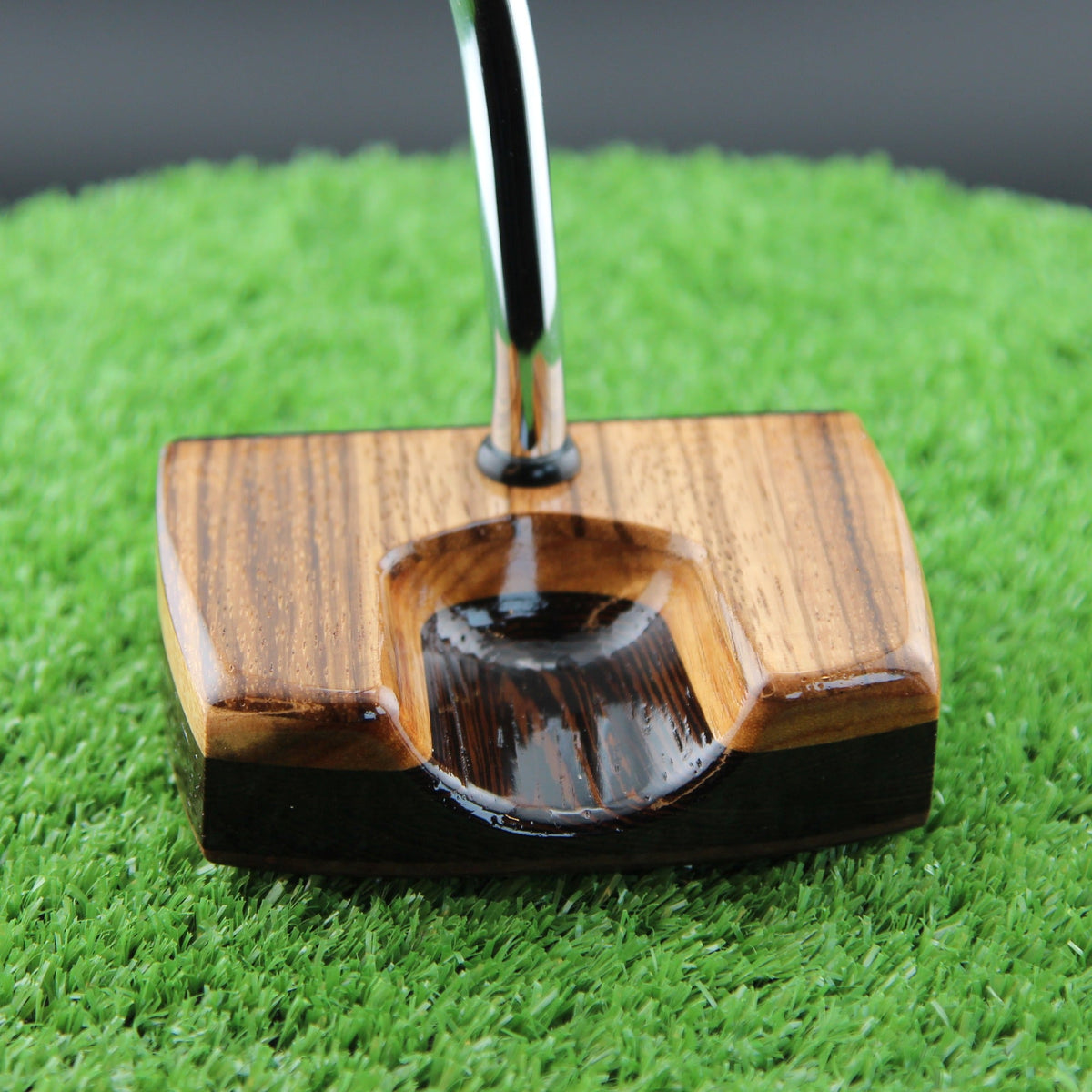
A Wenge putter is the darkest thing we build. Not stained, not dyed, not painted: Wenge comes out of the board a deep chocolate brown shot through with near-black streaks, and it only gets darker as the finish cures. If you've seen a TimberTouch head with a face so dark it looks like it was cut from shadow, that's Wenge. It shows up on more of our new builds than any other single wood, so it's overdue for its own guide.
Here's what Wenge is, where it comes from, how it behaves on the CNC and at impact, and which of our current putters carry it.

Signature Design · The Espresso
Espresso Woodrich Regal — Wenge Face, Leopardwood Body
$315 — zero torque, center shaft, two African woods
CNC-machined to exact tolerances, hand-finished in the shop — and ready for your custom engraving on the top and sole (+$40 at checkout).
Design Yours → Add to CartWhat Wenge Wood Is and Where It Comes From
Wenge (pronounced WHEN-gay) is a Central African hardwood, harvested mainly in the Congo basin across Cameroon, Gabon, and the Democratic Republic of Congo (Source: The Wood Database). The tree grows in swampy, moist forest, and the timber has been prized for decades in furniture, flooring, and musical instruments, where bass builders in particular use it for necks and fingerboards because it's stiff and stable.
The grain is straight, the texture is coarse and open-pored, and the color is the whole story: dark brown with fine black veins running the length of the board. Fresh off the saw it can look a little flat. Under finish it turns almost espresso-black, and the pale veins that were nearly invisible on the raw board pop out as thin light lines. It's the closest thing to Ebony that we can buy in the sizes a putter head needs.
Wenge is also heavy. It comes in around 54 pounds per cubic foot dry, with a Janka hardness of about 1,930 pounds-force (Source: The Wood Database). For comparison, that's harder than hard maple and roughly on par with the Padauk we pair it with so often. In putter terms, it's one of the few woods that can take a face impact for years without a dent.
Why Wenge Putters Feel the Way They Do
Density does two things at impact. It transmits vibration cleanly, and it resists compression. Wenge does both, which is why we use it as a face wood more than any other species in the shop right now: the Espresso, the SmokeHouse, the Black Ember, DARK CAT, and the Midnight all strike the ball off Wenge.
The feel is firm but not hard. Steel gives you a click; Wenge gives you a low, short "tock" and a little more sense of the ball staying on the face for a fraction longer. Golfers who came from a milled steel putter usually describe it as quieter and more solid at the same time. Golfers who came from an insert putter find it firmer than what they had, with more information coming back through the shaft on a mishit.
That density also matters for how we hit head weight. A Wenge face and a Wenge body layer carry more of the total grams on their own, so we need less lead in the pockets to reach a target weight, and we can put what's left exactly where it helps: far outside at the heel and toe for stability. On a Cedar or Canarywood body, the wood is doing less of that work and the lead is doing more.
Machining and Finishing Wenge
Wenge has a reputation among woodworkers for being miserable to work, and it's earned. The open grain splinters easily, the splinters go septic if you leave them in, and the dust is an irritant. Hand tools and sanding are where people get hurt.
The CNC side is the opposite. Once the blank is glued up and the CAD model is set, the mill cuts Wenge beautifully. It holds a crisp edge, it doesn't tear out at the sharp corners of a cavity or an engraving, and it machines to tolerance without the fuzz you get from softer woods. Fine engraving on a Wenge sole is some of the cleanest lettering we produce, because the dark wood makes the cut lines stand out like ink.
Finishing is where the patience goes. The open pores drink finish. We build coats until the surface is level and the grain is fully sealed, then hand-rub it out. That's what gives a finished Wenge head its depth: light goes into the pores and comes back out, so the surface looks darker than it actually is. It's also what makes it durable. Sealed Wenge shrugs off moisture and sun far better than the raw board would.
Woods That Pair With Wenge
Wenge is the anchor in most of our dark builds. Because it's so dark and so straight-grained, it makes almost any figured wood next to it look louder.
Leopardwood over Wenge is the combination behind the Espresso and DARK CAT: the spotted figure sits on a near-black base and looks like it's been lit from behind. Padauk against Wenge (the Black Ember, the MR1PUTT) is the high-contrast pairing, deep orange-red on black. Black Limba with Wenge, as on the SmokeHouse, is subtler: two smoky browns that read as one piece from a distance and reveal themselves up close. Canarywood and Wenge, the Black Fang, puts streaked gold against black.
If you like that dark, understated look, every one of those lives in the Zero Torque Center Shaft collection or the FATTY lineup, and each can be engraved on the top and sole.
Is a Wenge Putter Right for You?
Choose Wenge if you want a putter that looks serious at address. A dark face frames a white ball better than a light one does, and a lot of golfers find it easier to see the face line and the ball as a single picture. If you play with a black or dark steel putter now and want wood without a big visual change, Wenge is the natural step.
Choose Wenge if you want firm, clear feedback. It's the most steel-like feel in our wood lineup, and the one we'd recommend to a golfer who's nervous that wood will feel soft or dead.
Skip Wenge if what draws you to a wood putter is color and figure. It's handsome, but it's quiet. If you want the head to glow, look at Canarywood, Padauk, or Yellowheart and let Wenge be the accent stripe instead of the main event.
From the Shop
Pick Your Putter — Every One Can Be Engraved


Add custom engraving to any putter for $40 — just select the option on the product page.
Wenge Putter FAQ
What is Wenge wood?
Wenge is a dense Central African hardwood, dark brown with black streaks, harvested mainly in Cameroon, Gabon, and the Congo (Source: The Wood Database). With a Janka hardness around 1,930 lbf it's harder than hard maple, which is why it works as a putter face that resists dents and delivers firm, clear feedback.
Does a Wenge putter feel hard?
Firm, not harsh. It's the most steel-like wood in our lineup, with a low, short sound at impact and good feedback on off-center hits. If you're worried wood will feel soft, Wenge is the one to try.
Will Wenge fade or change color?
Under finish, Wenge darkens slightly over time and stays dark. It doesn't bleach the way some reddish woods can. Keep it out of a hot car and wipe it dry after wet rounds and it'll look the same for years.
Is Wenge sustainable?
Wenge is listed as endangered on the IUCN Red List because of harvest pressure (Source: The Wood Database). We buy in small quantities from established importers, use narrow stock, and put every offcut into inlays and accent layers rather than the scrap bin.
Choosing Your Wenge Build
If dark, quiet, and firm is your idea of a putter, start with a Wenge face and let the body decide the personality: Leopardwood for figure, Padauk for contrast, Black Limba for something that reads as one dark piece. Every head is CNC-machined to the same tolerances, weighed to its number, and hand-finished, so the only real decision is what you want to look at on the eighteenth green.
Make Your Mark on the Green
Every TimberTouch putter is designed in CAD, CNC-machined to exact tolerances, and hand-finished. Pick your Wenge build and we'll engrave your story into it.
Shop All Putters →First Look at New One-of-a-Kind Builds
Many of our putters are one of a kind — when they're gone, they're gone. Join the list and see new builds and engraving ideas before anyone else.
Share:
Are Wooden Putters Legal? A Maker Explains the Rules of Golf
Rosewood Putters: Old-World Warmth in a Precision-Machined Head