

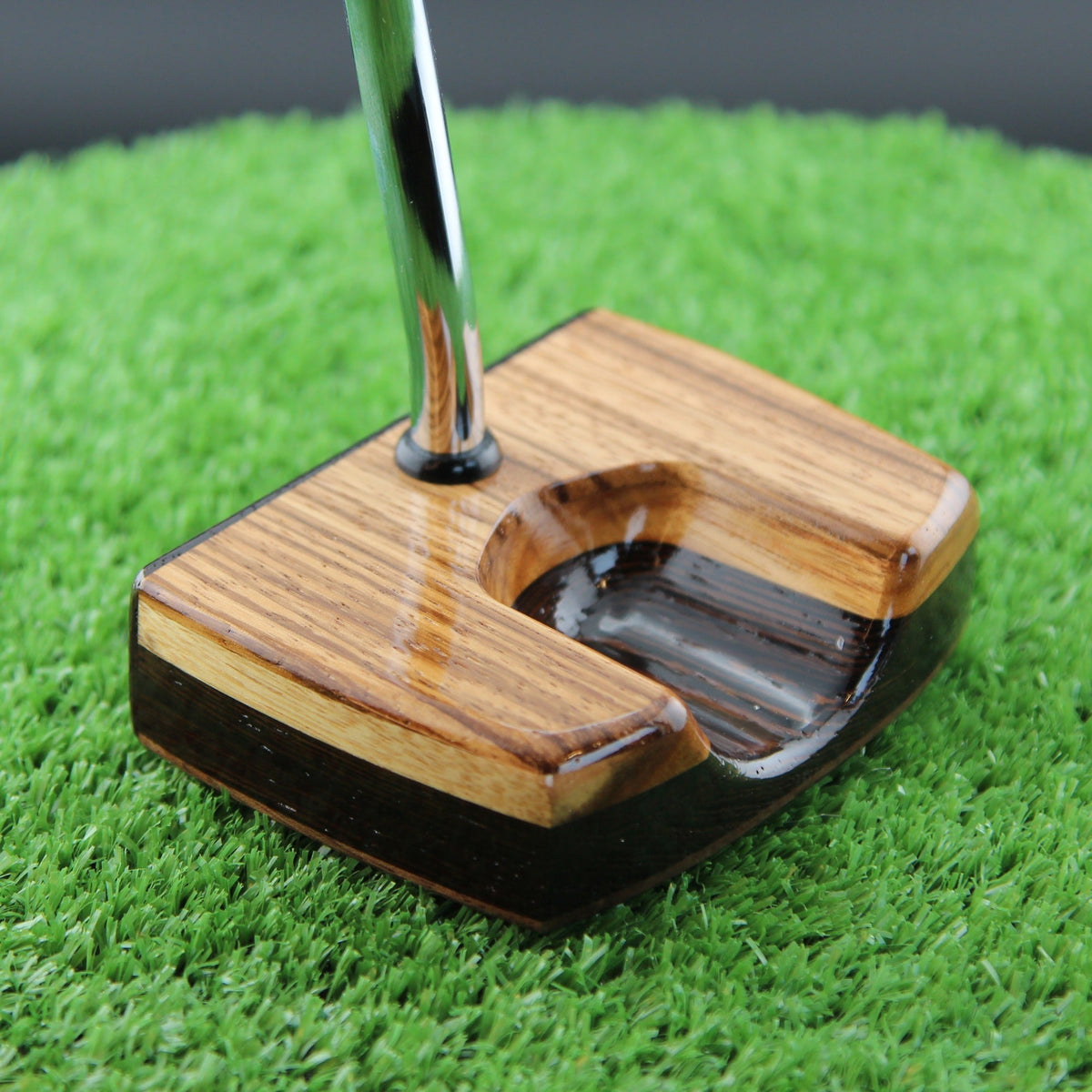
Are wooden putters legal? Yes — completely. It's the question we get most often from golfers seeing one of our putters for the first time, usually asked with a squint, as if a wood head must be breaking some rule. It isn't. The Rules of Golf regulate a club's dimensions, shape, and performance characteristics, not the material its head is made from. We build every putter in our shop to conform, and here's exactly how the rules work so you can play one in your Saturday match, your club championship, or a USGA-run event without a second thought.

Signature Design · The Topaz
Topaz Woodrich Regal — Zero Torque
$330 — golden Canarywood, center-shaft, fully conforming
CNC-machined to exact tolerances, hand-finished in the shop — and ready for your custom engraving on the top and sole (+$40 at checkout).
Design Yours → Add to CartWhat the Equipment Rules Actually Regulate
The USGA and R&A Equipment Rules govern things like club length, head dimensions, face flatness, and features such as adjustability. Nowhere do they require a putter head to be metal. Historically the opposite was true — for centuries every conforming putter was wood, and the rules grew up around wooden clubs. Steel became standard because of factories, not because of a rulebook.
Putters actually get more latitude than any other club. They're the one club allowed features like heads wider than they are long, certain grip shapes (a flat-sided putter grip is legal), and two striking faces in limited cases. The rulemakers treat putting as its own discipline, and material has never been part of the restriction.
The Requirements a Wood Putter Must Meet
A conforming putter — wood or otherwise — must have a shaft at least 18 inches long, a head that is plain in shape within the rules' meaning, and a face that is essentially flat and doesn't have features designed to unduly influence the ball's movement. Hardness of the face is not a putting restriction the way spring-like effect is for drivers; soft face materials are explicitly common in putters, which is why companies sell polymer and aluminum insert faces alongside steel.
Every head that leaves our shop is designed in CAD against those constraints before it's ever machined. The face is machined flat, the loft sits in the normal putter range, and the head profile is checked against the plain-in-shape requirements. CNC machining actually makes conformity easier to guarantee than hand shaping ever did — the tolerances are exact and repeatable.
What About Tournaments and Handicap Rounds?
For casual play, club events, and posting scores for your handicap, a conforming wood putter is no different from a steel one. For elite competitions that use the USGA's List of Conforming Clubs, note that the list applies to driver heads and golf balls — there is no conforming list a putter must appear on. A putter must simply meet the Equipment Rules, and a well-built wood putter does (Source: USGA Equipment Rules).
If a committee member ever raises an eyebrow, the burden is on the club's design, not its material. In several years of customers playing our putters in club championships and charity events, the only rules conversation anyone reports is other players asking where to get one.
Why the Question Comes Up at All
Two reasons. First, golfers under about sixty have never seen wood as standard equipment, so it reads as exotic. Second, people conflate the anchoring ban and various driver rules into a vague sense that “unusual equals illegal.” But the anchoring rule is about your stroke, not your putter, and the driver rules are about trampoline faces at 120 mph — neither has anything to do with what a putter head is made of.
There's a small irony here: a wood putter is closer to golf's original conforming equipment than anything else in your bag. Playing one isn't bending the rules. It's returning to them.
Does Wood Perform Differently — Legally?
Yes, and it's all within the rules. Combining hardwoods of different densities lets us tune weight distribution inside the head — dense wenge and rosewood at the perimeter for MOI, lighter woods in the core — the same engineering logic as any premium milled putter, executed in a material with naturally soft acoustics. The result is a conforming putter with a feel steel can't copy. Every current build in the newest putters collection is made to those same conforming specs.
Frequently Asked Questions
Are wooden putters legal in tournaments?
Yes. The Rules of Golf regulate a putter's dimensions, shape, and face — not its head material. A wood putter built to the Equipment Rules is legal in handicap rounds, club championships, and USGA-run competitions alike.
Is there a list my putter needs to be on?
No. The USGA's conforming lists cover driver heads and golf balls. Putters just need to meet the Equipment Rules; there is no putter registry.
Does the anchoring ban affect wood putters?
No. The anchoring rule (Rule 10.1b, effective 2016) restricts how you make a stroke — anchoring the club against your body — not what the putter is made of. It applies equally to every putter.
Can a putter face be made of wood?
Yes. Putter faces may be softer materials — that's why insert putters exist. A machined-flat hardwood face conforms, and its natural damping is part of why wood putters feel so soft.
Would a wood putter ever be ruled non-conforming?
Only for the same reasons a metal one would — a non-flat face, illegal dimensions, or prohibited features. Material alone never makes a club non-conforming.
From the Shop
Pick Your Putter — Every One Can Be Engraved


Add custom engraving to any putter for $40 — just select the option on the product page.
The Bottom Line
Wooden putters are fully legal, and always have been. If the only thing keeping you from putting with wood was a rules worry, that worry is settled — the remaining question is just which wood you want looking back at you over the ball.
Make Your Mark on the Green
Every TimberTouch putter is designed in CAD against the Rules of Golf, CNC-machined to exact tolerances, and hand-finished. Pick yours and we'll engrave your story into it.
Shop All Putters →First Look at New One-of-a-Kind Builds
Many of our putters are one of a kind — when they're gone, they're gone. Join the list and see new builds and engraving ideas before anyone else.
Share:
Putter Head Weight: Heavy vs Light, and How to Pick Yours
Wenge Putters: The Near-Black African Hardwood Behind Our Darkest Builds