

Putter head weight is the spec almost nobody asks about and almost everybody feels. Two putters can share the same head shape, the same length, the same loft, and putt like completely different clubs because one weighs 340 grams and the other weighs 375. We build heads across that whole range in my shop, and every one of them is weighed on a gram scale before it gets a shaft, so I have a clear view of what weight actually changes in your stroke and what it doesn't.
This guide covers what the numbers mean, what the testing says about heavy versus light, how green speed and putter length fit in, and how we hit a target weight in an exotic wood head. Then you can decide which band belongs in your bag.

Signature Design · The Arariba
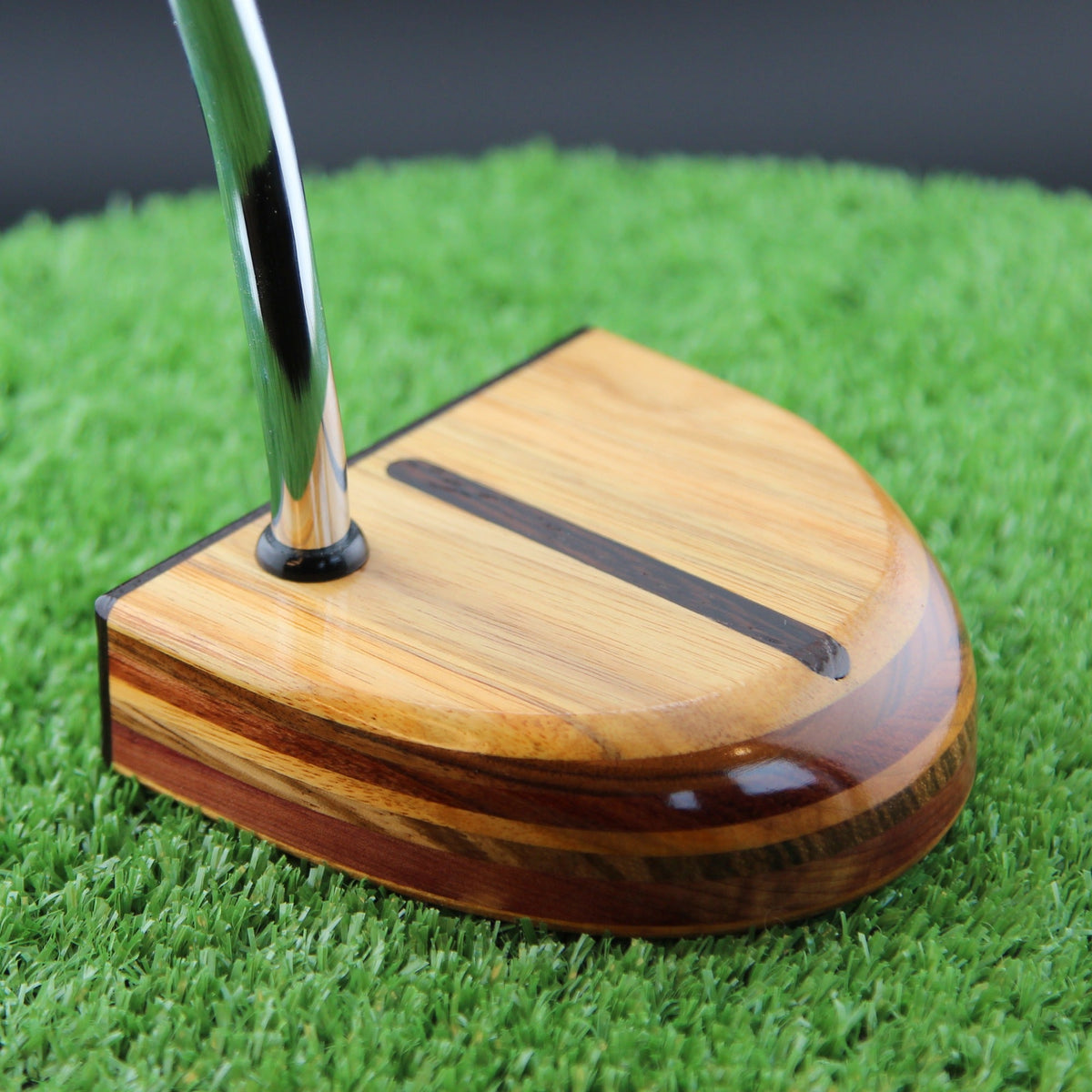
Arariba FATTY — Canarywood, Wenge & Cedar
$325 — 370-gram mallet, top of our Standard band
CNC-machined to exact tolerances, hand-finished in the shop — and ready for your custom engraving on the top and sole (+$40 at checkout).
Design Yours → Add to CartWhat Putter Head Weight Actually Means
Head weight is the mass of the putter head alone, in grams, before the shaft and grip go on. It is not the same as swing weight (how heavy the club feels when you swing it) or total weight (everything on the scale), though all three are related. Head weight is the one you can compare across brands, because it's a fixed number that doesn't change with your grip choice.
For years, 350 grams was considered a hefty head. Now it's average, and putters well over 400 grams are easier to find than ones near 300. Most production putters today land somewhere in the 330 to 370 gram window.
In our shop we sort every head into three bands, and these are the same bands you'll see on our collection pages:
| Band | Head weight | Feels like |
|---|---|---|
| Light | 344 g and under | Quick, responsive, lots of feedback through the hands |
| Standard | 345 – 374 g | The familiar middle; what most golfers grew up on |
| Heavy | 375 g and up | Deliberate, pendulum-like, harder to rush |
Those cutoffs aren't magic numbers. They're where we've found the feel changes enough that a golfer notices it without being told.
Heavy vs Light Putter: What the Testing Says
The marketing story is that a heavier putter smooths your stroke and sharpens your distance control. The most rigorous public test I've seen doesn't back that up. Plugged In Golf ran eight golfers through 325, 340, and 355 gram heads on identical fitting putters, tracked with SAM PuttLab and real putts from 8, 20, and 40 feet. They found nothing to indicate that heavier heads improved stroke consistency or distance control; roughly as many players were better with the light head as the heavy one, and on mid-range putts the heaviest head actually did worst.
One finding did lean heavy. On 8-foot putts, three out of four testers holed the most putts with the heaviest head, even though the PuttLab data couldn't explain why. The difference was often a single putt out of seven, but a single putt per round is worth having.
The other thing the test showed: most golfers were best with a different weight at different distances. Nobody has one perfect number. What you're really choosing is which part of the green you want to optimize for.
How We Hit a Target Putter Head Weight in Wood
Here's where a wood build is different from a milled steel one, and it's worth understanding if you care about how weight is distributed rather than just how much of it there is.
A steel head is heavy everywhere. A wood head isn't. Wenge, Leopardwood, and Bubinga are dense hardwoods, but they're still far lighter than steel, so the body of the head carries only part of the total. The rest comes from lead weighting we design into the CAD model, and we put it far outside, at the heel and toe, where it does the most for stability. That's the same approach I explained in our MOI post: a light body plus heavy perimeter gives you a more forgiving head at the same total grams.
Wood also isn't uniform. Two Canarywood blanks from the same board can differ noticeably in density, which is why every head gets weighed after machining and before the weights are set. Adjusting the weight pockets is how I bring each head to its number. That process is why our Espresso zero-torque Woodrich Regal comes in at 350 grams while the Arariba FATTY lands at 370: same tolerances, different head volume and a different job.
If you already know you want the deliberate feel of a heavy head, our Heavy Putters collection filters the shop down to builds at 375 grams and up. Most of those are FATTY mallets, where the larger footprint gives me the room to place that extra mass where it helps.
Green Speed, Putter Length, and Weight
Two rules of thumb float around on putter weight, and they contradict each other.
The first says heavier heads for fast greens: a heavy putter stabilizes the short, gentle stroke you use when the ball rolls easily. The second says lighter heads for fast greens, because you want a delicate touch and more feel. You'll find good putters on both sides of that argument, and I don't think either rule is worth building your whole decision on. Your tempo matters more than the stimp reading. A golfer with a slow, sweeping stroke usually prefers weight; a golfer with a quick, handsy stroke usually prefers less of it.
Length is the rule that actually holds. When a putter gets shorter, the head generally gets heavier to keep the swing weight balanced. Some manufacturers add about 10 grams per inch as you drop from 35 inches to 33 (Source: The Power Fade). If you order a 33-inch putter, expect (and want) a heavier head than the 35-inch version of the same model.
One honest caveat: a heavy head will not fix a stroke that's already too long or too fast. It will just make the miss go further past the hole. Fix the tempo first, then choose the weight that suits it.
Which Putter Head Weight Should You Choose?
Use these as starting points, then test them on real grass if you can.
Go Light (344 g and under) if you rely on feel for distance, play a lot of long lag putts, or have a compact stroke and quick tempo. Light heads also suit golfers who find heavy putters make them "steer" the ball on short putts.
Go Standard (345 to 374 g) if you don't have a strong preference yet. This is the band most golfers already play, and it's where I build the majority of our Woodrich Regal mid-mallets. It's the safest place to start, especially as a gift for someone whose stroke you can't watch.
Go Heavy (375 g and up) if you struggle inside eight feet, get wristy under pressure, or prefer a stroke you can feel the whole way back and through. Heavy heads reward a smooth, unhurried motion and punish a jab.
If you're between bands, lean toward the lighter one and let the perimeter weighting do the stabilizing work. That's the advantage of a high-MOI wood head: you get forgiveness without having to carry extra grams to find it.
From the Shop
Pick Your Putter — Every One Can Be Engraved


Add custom engraving to any putter for $40 — just select the option on the product page.
Putter Head Weight FAQ
Is a heavier putter better?
Not by default. Controlled testing found no consistent improvement in stroke consistency or distance control from heavier heads, though most golfers did hole more 8-foot putts with the heaviest option (Source: Plugged In Golf). A heavy putter helps a smooth, unhurried stroke and can hurt a quick one, so match the weight to your tempo rather than assuming more is better.
What is a standard putter head weight?
Most production putters sit between about 330 and 370 grams, with 350 now a common midpoint. I class 345 to 374 grams as Standard, under 345 as Light, and 375 and up as Heavy.
Should I use a heavier putter on fast greens?
Opinions split. Some golfers like extra head weight to steady a short stroke on quick greens; others go lighter for more touch. Your stroke tempo is a better guide than the green speed, so test both if you can.
Does putter length affect head weight?
Yes. Shorter putters normally get heavier heads to keep the swing weight balanced, often around 10 grams per inch. A 33-inch putter usually carries a heavier head than the same model at 35 inches.
Can you add weight to a putter?
Often, yes. Many heads have adjustable sole weights, and lead tape is a simple way to test a few extra grams before committing. On my builds, weight lives in internal lead pockets set during the build, so tell me the number you want and I'll build to it.
Choosing Your Weight
If you take one thing from this: the right putter head weight is the one that matches the stroke you actually make, not the one on a spec sheet. Quick and handsy leans light. Long and smooth leans heavy. Unsure leans Standard, and lets the perimeter weighting carry the forgiveness. Every head that leaves my shop is weighed to its number, so whichever band you land in, you'll know exactly what's in your hands.
Make Your Mark on the Green
Every TimberTouch putter is designed in CAD, CNC-machined to exact tolerances, and hand-finished. Browse by weight, pick yours, and we'll engrave your story into it.
Shop All Putters →First Look at New One-of-a-Kind Builds
Many of our putters are one of a kind — when they're gone, they're gone. Join the list and see new builds and engraving ideas before anyone else.
Share:
Broomstick and Face-On Putting: Who They Help and How to Get Fit
Are Wooden Putters Legal? A Maker Explains the Rules of Golf