

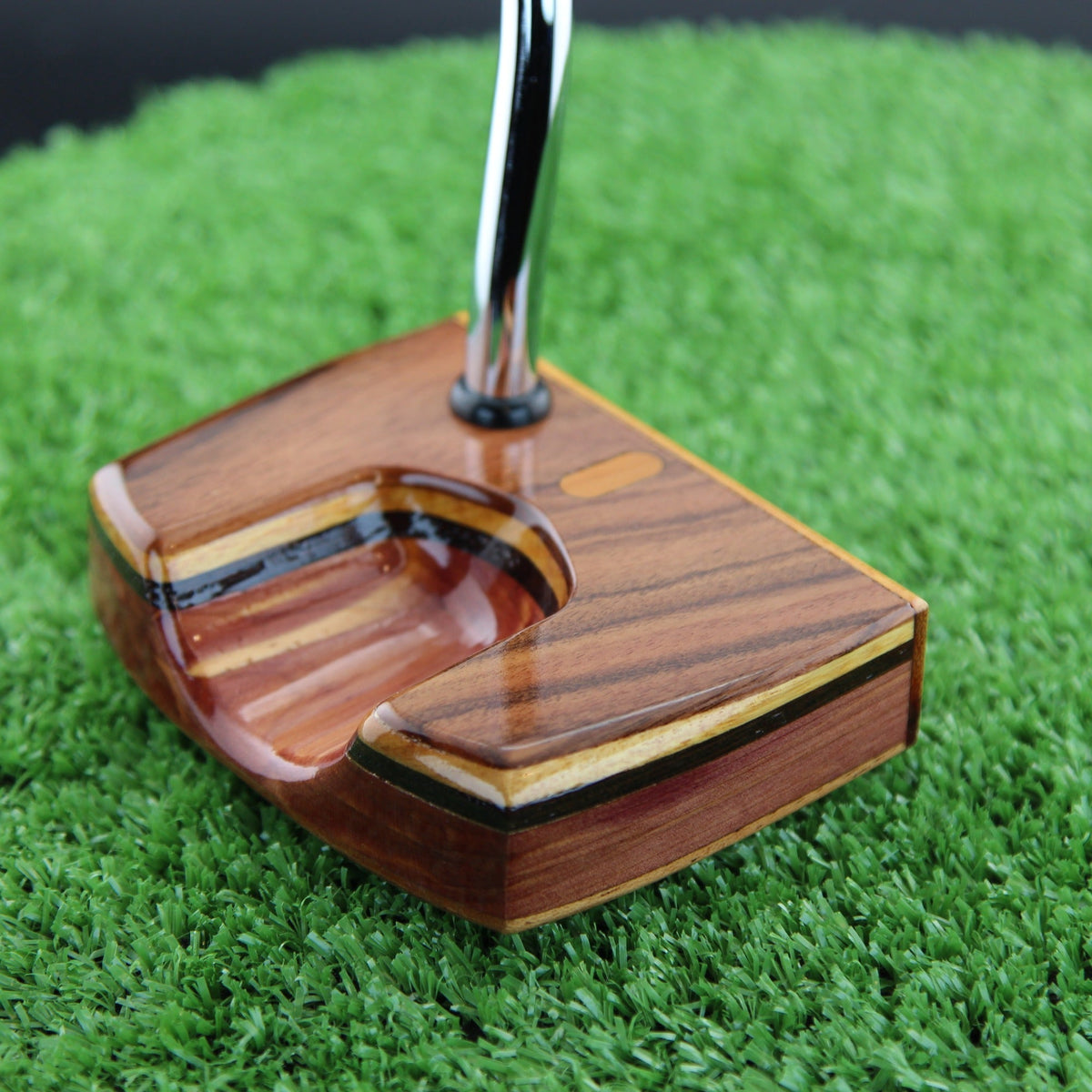
A rosewood putter carries more history in its grain than anything else we build. Rosewood is the wood of concert guitar backs, heirloom furniture, and — golfers may remember — some of the most storied persimmon-era clubmaking accents ever made. When we lay rosewood into a putter head, we're working with a material that instrument makers have fought over for centuries, and for the same reasons we want it: density, stability, and a warm, dark figure that looks lit from within. Here's what rosewood actually does in a modern, CNC-machined putter.

Signature Design · The Aurora
Aurora — Rosewood Woodrich Regal
$299 — dense rosewood warmth behind a padauk face
CNC-machined to exact tolerances, hand-finished in the shop — and ready for your custom engraving on the top and sole (+$40 at checkout).
Design Yours → Add to CartWhat Makes Rosewood Special
True rosewoods (the Dalbergia family) are dense, oily, richly colored hardwoods ranging from reddish-brown to deep chocolate, usually with darker veining that swirls rather than stripes. That density is the headline for a putter maker: rosewood is among the heavier woods on our rack, which makes it a powerful tool for controlling head weight and balance. Where walnut gives us a light, stable field, rosewood lets us place real mass exactly where the CAD model wants it — the same job tungsten plugs do in premium metal putters, done instead by the wood itself.
Instrument makers prize rosewood for its resonance — the way it returns energy with a warm, complex note. You're not strumming your putter, but you do feel it: rosewood-layered heads deliver a strike that owners describe as dense and buttery, solid in the hands without a hint of harshness.
Rosewood in the Stack
In our laminated builds, rosewood usually plays one of two roles. As a body wood, it anchors the head with weight and gives the whole build that old-library warmth — recent examples pair it with cedar and mahogany tones for a fully classic look, or with canarywood for a shot of gold against the dark. As an accent, a single rosewood layer adds visual depth that flat-colored woods can't match, because the figure shifts as the putter moves in the light. Either way, it machines cleanly and polishes to a glassy, deep luster under the finish.
A Note on Responsible Sourcing
Rosewood's fame created real conservation pressure, and several rosewood species are protected under international trade rules. We take that seriously. The rosewood stock in our shop comes through legitimate suppliers of legally traded material, and we buy in the modest quantities a precision shop of our size actually needs — boards, not shipping containers. Part of what you're getting in a small-batch putter is a maker who knows exactly where every board came from.
From the Shop
Pick Your Putter — Every One Can Be Engraved


Add custom engraving to any putter for $40 — just select the option on the product page.
Who Should Play a Rosewood Build
Rosewood is for the golfer whose taste says heirloom: the player who'd pick a leather grip over a neon one and a mechanical watch over a smartwatch. It's the most traditional-looking wood we offer while still being unmistakably premium — nobody mistakes rosewood figure for stained pine. It also suits players who want a bit more heft in the head, since rosewood-forward builds naturally carry their weight low and solid. You'll find current rosewood builds among our specialty and one-of-a-kind putters, and like everything there, each one is a single edition — the figure in that head exists nowhere else.
Frequently Asked Questions
Is rosewood good for a putter?
Yes — arguably ideal. Rosewood is dense, dimensionally stable, and warm-feeling at impact, which lets a maker control head weight naturally while delivering the soft-solid strike wood putters are known for. Its swirling dark figure is also among the most beautiful in clubmaking.
Is rosewood legal to buy and own?
Yes. Trade in some rosewood species is regulated internationally, but legally sourced rosewood is available through legitimate suppliers, which is where our stock comes from. Owning and playing a rosewood putter is no issue at all.
How does rosewood compare to walnut in a putter?
Rosewood is noticeably denser and darker-figured; walnut is lighter, calmer, and more even-toned. We often use them together — walnut for stable structure, rosewood for mass and drama.
Does rosewood need special care?
No. Once sealed under the finish, it needs the same simple routine as any of our putters: wipe dry after wet rounds, use the headcover, stay out of hot cars.
The Bottom Line
Rosewood earned its legend in concert halls and heirloom furniture long before we put it on a green. In a CAD-designed, precision-machined head, it does double duty: engineered mass placement and a depth of figure no other wood matches. If your ideal putter looks like it belongs in a walnut-paneled study, rosewood is your wood — and when a build speaks to you, don't wait, because there's only ever one.
Make Your Mark on the Green
Every TimberTouch putter is designed in CAD, CNC-machined to exact tolerances, and hand-finished. Pick yours and we'll engrave your story into it.
Shop All Putters →First Look at New One-of-a-Kind Builds
Many of our putters are one of a kind — when they're gone, they're gone. Join the list and see new builds and engraving ideas before anyone else.
Share:
Wenge Putters: The Near-Black African Hardwood Behind Our Darkest Builds
Mid-Mallet vs Full Mallet Putter: A Maker's Guide to Picking the Right Head