

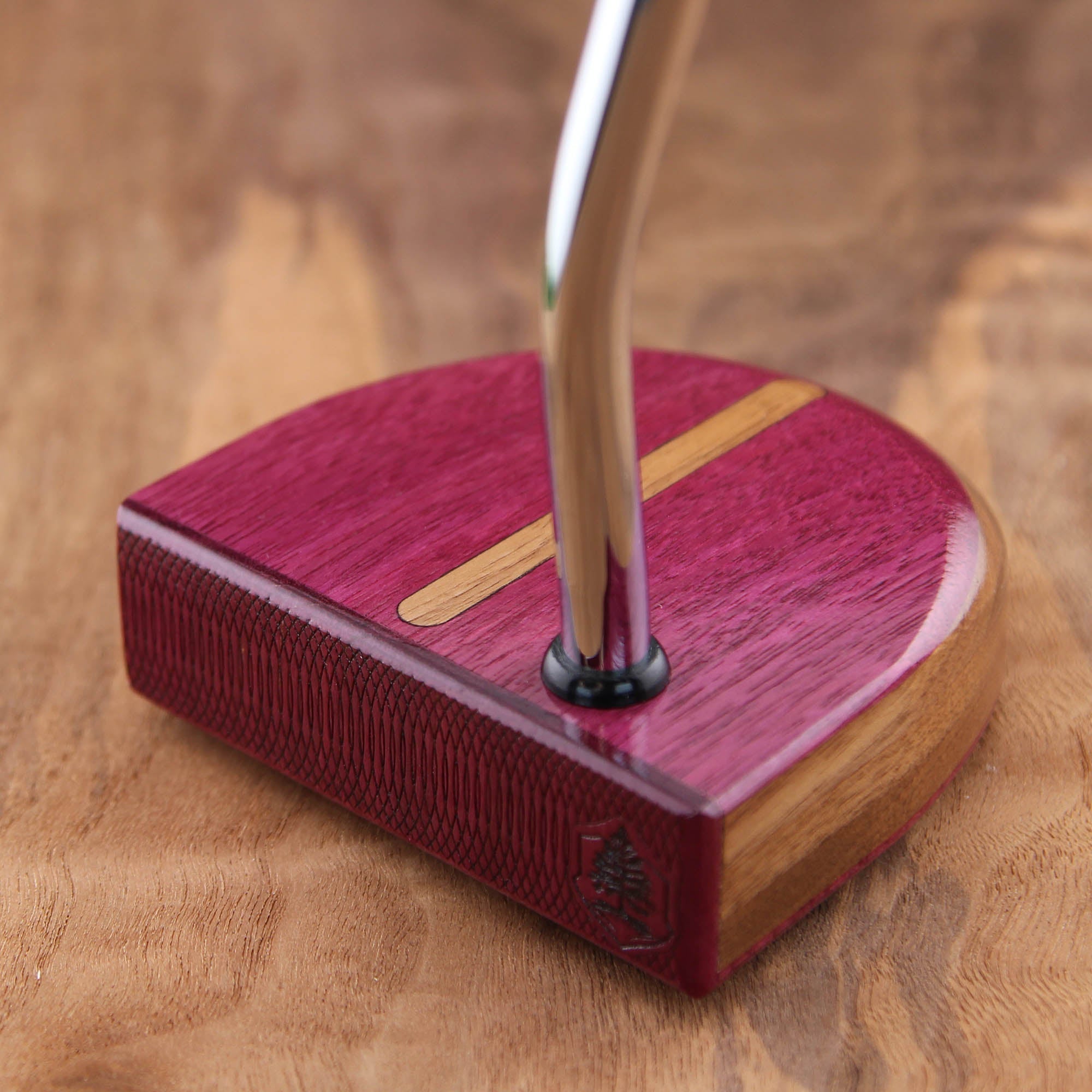
Every so often at a show, someone picks up a Purpleheart putter and asks what color stain I used. The answer surprises them every time: none. Purpleheart is one of the only woods on earth that is genuinely, naturally purple — and it's one of the hardest woods I put on my bench.

Signature Design · The Plumbline
Plumbline — Purpleheart & Walnut FATTY
$305 — naturally purple Purpleheart over rich Walnut
CNC-machined to exact tolerances, hand-finished in the shop — and ready for your custom engraving on the top and sole (+$40 at checkout).
Design Yours → Add to CartWhere Purpleheart Comes From
Purpleheart (Peltogyne species) grows in the tropical forests of Central and South America — Brazil, Guyana, Suriname. Freshly cut, the heartwood is a dull grayish-brown. Then air and light get to it, and within days it turns a vivid violet-purple. Give it more sun over the months and it deepens toward a rich royal purple, then eventually a purple-brown with age.
That color change isn't a flaw — it's the wood living. Two golfers who buy the same Purpleheart putter a year apart will own two slightly different colors, and both will be beautiful.
What Purpleheart Brings to a Putter
Serious hardness. Purpleheart is dramatically harder than domestic hardwoods — well above Hard Maple on the Janka scale. As a face material it's about as tough as wood gets, which is why it shows up on the faces of several of our builds, including the Tyrian and Amaranth Regals.
A firm, precise strike. Harder face woods give a crisper feel and slightly livelier response. Purpleheart sits right at that firm end — golfers who like a solid, definite impact tend to love it.
Color no one else has. On the first tee, on the practice green, in the bag — nothing else looks like it. Purple with zero dye is a conversation every round.
How I Work With It
Purpleheart fights back. It's hard on cutting edges and can be brittle at sharp corners, so I machine it with fresh tooling and respect. The reward is a surface that sands to glass and holds crisp detail — which matters, because we laser engrave every face to a consistent depth chosen to grip the ball and start it rolling sooner. Engraving into Purpleheart produces beautiful contrast: the char sits dark against that violet field.
Under our weather-tough finish, the color is sealed but not frozen — UV still reaches the wood, so your putter will keep deepening toward royal purple with every sunny round. I tell customers it's the only putter that gets more regal the more you play it.
Purpleheart FAQ
Is Purpleheart really purple naturally?
Yes — no stain or dye involved. The heartwood oxidizes to violet-purple within days of cutting and deepens with sun exposure over time. It's one of very few truly purple woods on earth.
Is Purpleheart a good putter face wood?
One of the best. It's far harder than Maple, extremely wear-resistant, and gives a firm, crisp strike — and its density helps us hit precise head weights for high-MOI designs.
How do I keep the purple color?
You don't need to do anything — the finish protects the wood. The color will slowly deepen with sunlight, which most owners consider the best part.
From the Shop
Pick Your Putter — Every One Can Be Engraved


Add custom engraving to any putter for $40 — just select the option on the product page.
The Bottom Line
Purpleheart is proof that nature out-designs any paint booth: a wood hard enough for a lifetime of putts, in a color you couldn't order from a catalog. If you want a putter that's both a tool and a story, this is the wood.
Make Your Mark on the Green
Every TimberTouch putter is designed in CAD, CNC-machined to exact tolerances, and hand-finished. Pick yours and we'll engrave your story into it.
Shop All Putters →First Look at New One-of-a-Kind Builds
Many of our putters are one of a kind — when they're gone, they're gone. Join the list and see new builds and engraving ideas before anyone else.
Share:
The Texas Wedge: Why Your Worst Putt Beats Your Worst Chip
Canarywood Putters: The Streaked Gold Behind Our Wild Side