

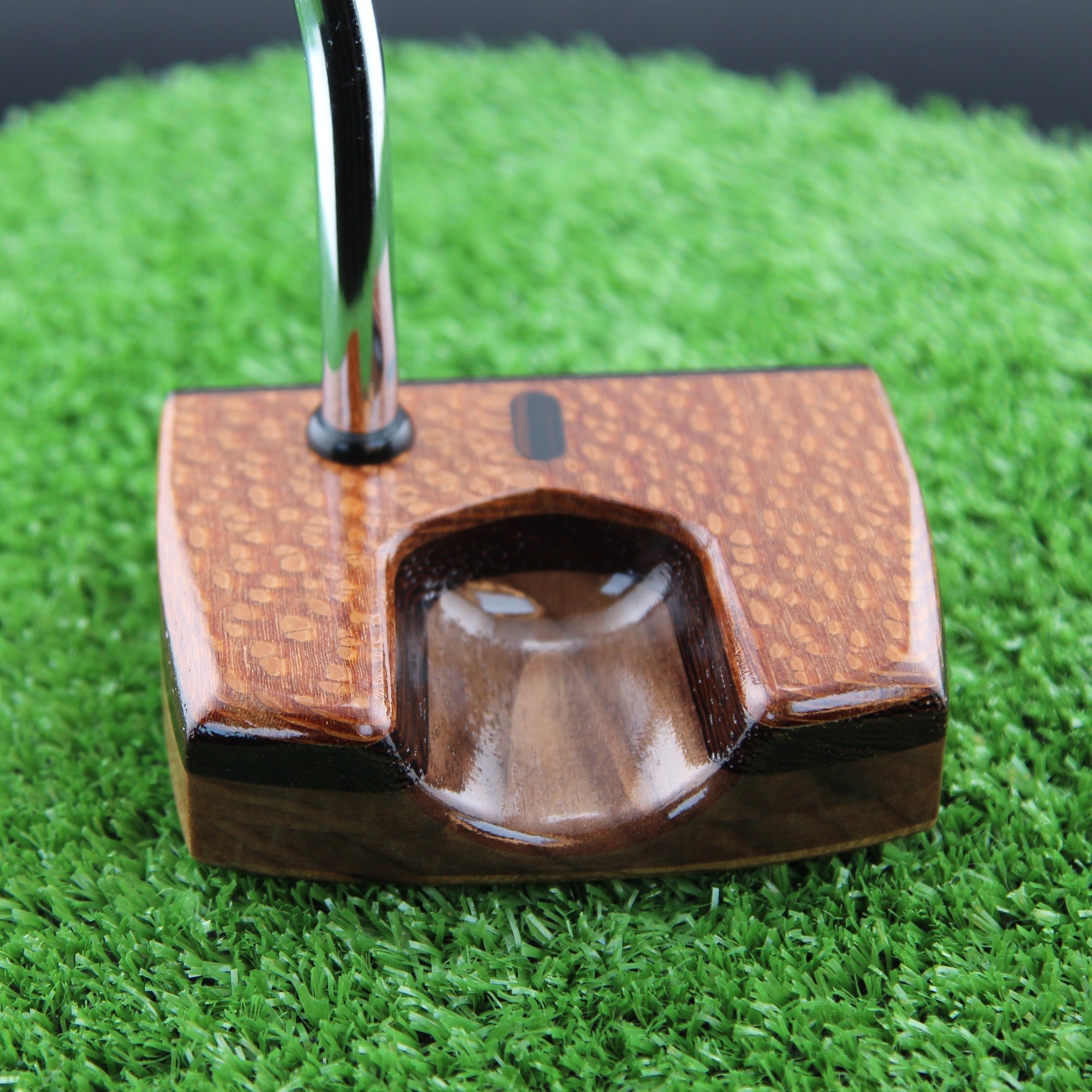
Leopardwood earns its name the moment light hits it. Cut the board correctly and the surface breaks into hundreds of small, shimmering flecks — like the coat of the big cat it's named for. I've been building leopardwood putters in my shop for a while now, and lately they've taken over my bench: four of my last five builds feature it. This guide covers what leopardwood actually is, why the figure only shows up when it's cut right, how the wood behaves at impact, and how I pair it in a putter head.

Signature Design · The Tuxedo
Tuxedo — Zero-Torque Center Shaft Blade
$310 — five woods in one tuxedo-sharp stack
CNC-machined to exact tolerances, hand-finished in the shop — and ready for your custom engraving on the top and sole (+$40 at checkout).
Design Yours → Add to CartWhat Is Leopardwood?
Leopardwood is a South American hardwood, medium to dark reddish brown, with unusually wide medullary rays — the cellular structures that radiate out from the center of the tree. Those rays are what create the spots. When a board is quartersawn, the rays get sliced across their face and show up as bold, lens-shaped flecks scattered over the surface (Source: The Wood Database). Flat-sawn, the same board looks almost plain. That's the first thing to understand about leopardwood: the leopard is only in there if the sawyer and the builder put it on display.
You'll sometimes see leopardwood confused with lacewood, a lighter, softer cousin with a similar lacy figure. They're related in appearance but not in behavior — true leopardwood is roughly twice as dense and dramatically harder than lacewood (Source: The Wood Database). For furniture that distinction is academic. For a putter that has to strike a golf ball thousands of times, it's everything. I build with the real thing.
Why Leopardwood Works in a Putter
A putter head wants two things from its wood: enough density to feel solid and stable through the stroke, and enough hardness to hold a crisp face over years of impacts. Leopardwood delivers both. It's a genuinely hard, heavy wood — rated very durable, dense enough that woodworkers complain about it dulling their planes (Source: The Wood Database). In my shop that difficulty is a feature. The same density that makes it stubborn under a hand plane makes it ring solid off the face.
The feel is what surprises people. Dense exotic hardwoods give you an organic, muted click at impact — feedback you feel in your hands rather than hear as a metallic ping. Leopardwood sits at the firm end of my wood lineup, so the sensation is crisp and immediate. If you like knowing exactly where on the face you struck the ball, this wood tells you.
Working Leopardwood: A Maker's Honest Notes
I'll be straight with you: leopardwood is one of the harder woods I shape. The same medullary rays that create the spots want to flake and tear out if you plane against them. Sharp tools, light passes, and patience are the whole recipe. Sanding through the grits takes longer than it does with cedar or walnut, but the payoff is a surface that polishes like stone — the flecks go glassy and seem to float under the finish.
Orientation matters more with leopardwood than almost any wood I use. I position each blank so the quartersawn face — the spotted face — lands where your eye falls at address. Two putters cut from the same board can look completely different depending on how the maker orients the grain. That's a decision made at the bench, not at the lumberyard.
What I Pair It With
Leopardwood's reddish-brown base tone and busy figure ask for calmer partners. My favorite pairings from recent builds:
Wenge and walnut. Deep chocolate-to-black woods that frame the flecks and let them jump. This is the combination behind the darkest, most dramatic putters on my bench.
USA red cedar. Cedar's warm, straight grain gives the eye a resting place next to leopardwood's spots, and the contrast in weight lets me fine-tune head balance.
Curly maple. Light, shimmering stripes against dark spotted figure — two kinds of movement in one head. When the light catches both at once, the putter looks alive.
Every leopardwood blank has its own spot pattern, so no two builds repeat. Several of my newest leopardwood putters are in my Specialty and One of a Kind collection right now — each one photographed individually, because the putter in the photo is the exact putter that ships.
From the Shop
Pick Your Putter — Every One Can Be Engraved


Add custom engraving to any putter for $40 — just select the option on the product page.
Leopardwood Putter FAQ
Is a leopardwood putter durable enough for regular play?
Yes. Leopardwood is a dense, hard exotic wood rated very durable — harder than many woods used in flooring. A properly finished leopardwood putter handles regular rounds without denting or wearing at the face. Impact with a golf ball is gentle work for wood this hard.
What makes the spots on leopardwood?
The spots are medullary rays — natural cell structures in the tree — exposed by quartersawing the board. They're not stain, dye, or burning. The pattern runs through the wood, so it can't wear off.
Is leopardwood the same as lacewood?
No. They look similar, but true leopardwood is far harder and about twice as dense as lacewood. I use leopardwood because that density is what a putter face needs.
Does the spotted figure affect the roll?
No. The figure is visual — the striking face is milled flat and true regardless of the pattern. What the density does affect is feel: leopardwood gives a firm, crisp response at impact.
Are wood putters legal for tournament play?
Wood heads are permitted under the equipment rules — golf's first putters were wood, and nothing in the modern rules prohibits a wooden head that meets standard dimensional requirements. If you play sanctioned events, check with your committee like you would for any club.
Finding Yours
If you're just starting to look at wood putters, begin with how you want impact to feel: leopardwood suits players who want firm, immediate feedback. If you've already played a wood putter and want something nobody else on your course has, leopardwood's one-of-a-kind spot patterns are about as individual as golf equipment gets. And if one of the current builds catches your eye, don't wait on it — when a one-of-a-kind putter sells, that exact pattern is gone for good. That's not a sales line; it's just how quartersawn leopardwood works.
Make Your Mark on the Green
Every TimberTouch putter is designed in CAD, CNC-machined to exact tolerances, and hand-finished. Pick yours and we'll engrave your story into it.
Shop All Putters →First Look at New One-of-a-Kind Builds
Many of our putters are one of a kind — when they're gone, they're gone. Join the list and see new builds and engraving ideas before anyone else.
Share:
Padauk Putters: The Reddish-Orange Wood That Glows on the Green
Yellowheart Putters: Golf's Brightest Natural Wood, No Dye Required