
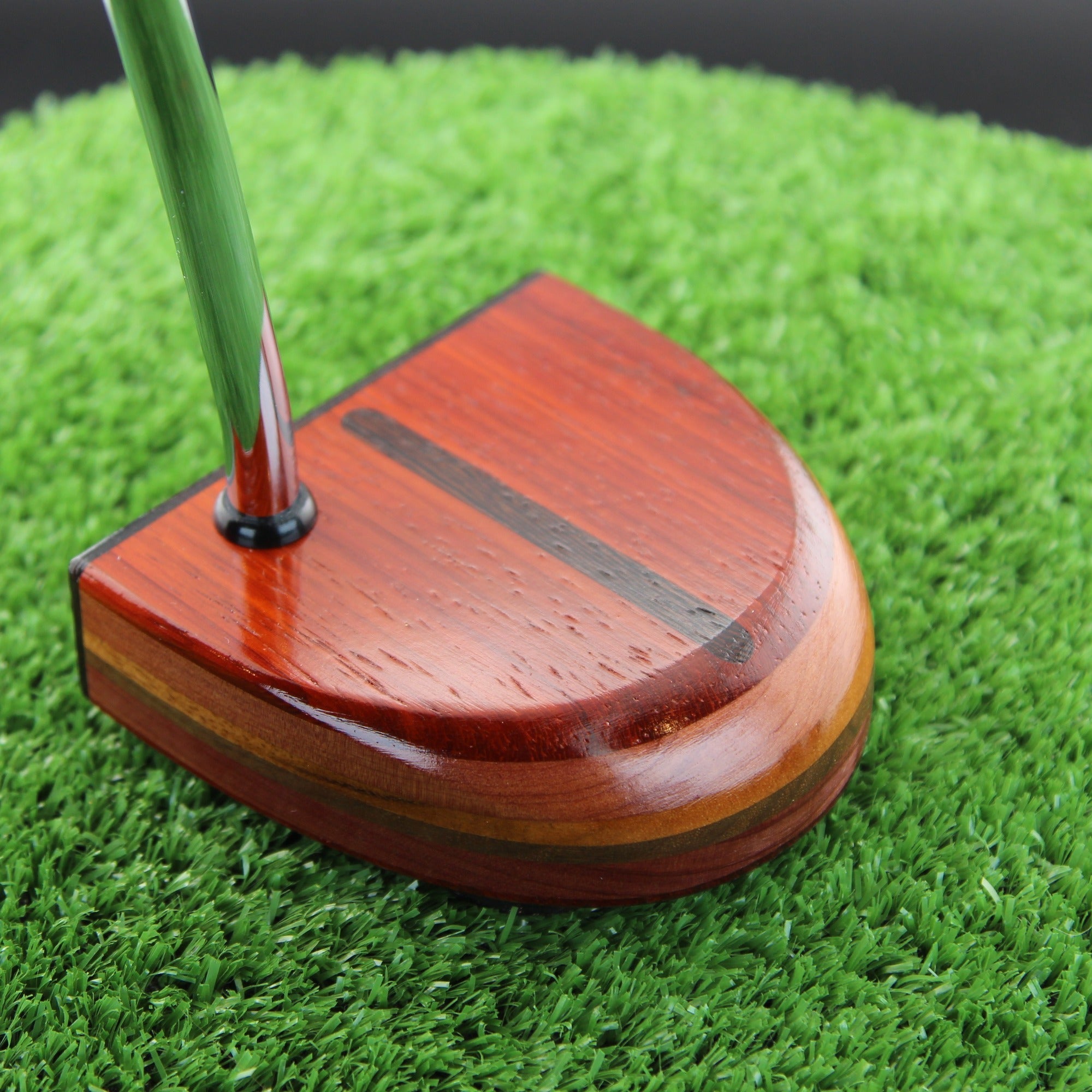
The first time I ran a padauk blank through the saw in my shop, the offcut looked like it had been dipped in sunset. A padauk putter is the loudest thing I build — not in sound, in color. Freshly milled African padauk is a vivid reddish-orange that no stain or dye can fake, and when I pair it with dark walnut and streaked canarywood in a putter head, people stop mid-round to ask about it. Here's what padauk actually is, how it behaves in a precision-machined putter, and whether it's the right wood for your game.

Signature Design · The MR1PUTT
MR1PUTT — Zero-Torque Padauk & Wenge FATTY
$299 — padauk's orange fire framed in near-black wenge
CNC-machined to exact tolerances, hand-finished in the shop — and ready for your custom engraving on the top and sole (+$40 at checkout).
Design Yours → Add to CartWhat Is Padauk Wood?
African padauk (Pterocarpus soyauxii) grows in central and west Africa, and woodworkers prize it for two things: that unmistakable orange-red heartwood and its stability. It machines cleanly, holds crisp edges, and resists movement once it's sealed — all things that matter a great deal when you're CNC-machining a putter head to exact tolerances and hand-finishing it afterward, which is how every putter leaves my shop.
On the Janka hardness scale, padauk rates about 1,970 lbf — harder than hard maple and roughly 50% harder than white oak (Source: The Wood Database). In practical terms, this is not a delicate wood. It shrugs off the kind of contact a putter face actually sees, which is a golf ball arriving at putting speed, over and over, for years.
Why Padauk Works in a Putter
Color gets padauk in the door, but it stays in my wood rack because of how it performs in a laminated head. I build putters from multiple hardwood layers, each chosen for density, grain direction, and stability, then machined as one solid billet. Padauk pulls its weight in that stack three ways.
First, density. At putting-stroke speeds, a dense hardwood face delivers a soft but solid feel — none of the click you get off some milled metal faces, but no mushiness either. The ball comes off with a muted, wooden note that most golfers describe as quiet confidence.
Second, stability. Padauk's low movement in service means the head I machine in July is the same head in your hands next July. Combined with a full sealing finish, it holds its geometry — face angle, loft, lie — the way a precision instrument should.
Third, contrast. Padauk against walnut is the highest-contrast pairing I make. The orange band draws your eye straight down the topline, which some golfers find genuinely useful as an alignment aid, the same way a sight line works on a painted mallet.
Does the Color Last?
Honest answer: padauk changes. With UV exposure, that fresh neon orange gradually deepens toward a rich reddish-brown . Two things about that. Every padauk putter we build gets a UV-resistant finish that slows the shift considerably. And the change isn't decay — it's patina. A padauk head that's mellowed to deep burgundy-red looks like a well-loved instrument, not a faded one. If you want to keep it as bright as possible, store it in the headcover and out of the rear windshield of your car, same as you'd treat any fine wood.
How We Build With Padauk
Padauk earns its place in our one-of-a-kind builds, where we match woods the way you'd match tonewoods on a guitar. The newest example in the shop is a Woodrich Regal mid-mallet that layers padauk with walnut and canarywood — three continents of hardwood in one high-MOI head, designed in CAD and CNC-machined before hand-finishing. You can see that build and its siblings in my Woodrich Regal mid-mallet collection. Because every blank of padauk is figured differently, no two of these putters are ever quite the same — when one sells, that exact combination is gone.
One machining note from the shop: padauk dust is famously orange and gets everywhere. It's a small price. The wood cuts beautifully, takes finish evenly, and polishes to a glow that photographs can only approximate.
From the Shop
Pick Your Putter — Every One Can Be Engraved


Add custom engraving to any putter for $40 — just select the option on the product page.
Padauk vs. Other Exotic Putter Woods
If you're choosing between the woods I work with: zebrawood gives you dramatic stripes, leopardwood gives you spotted figure, purpleheart gives you the only naturally purple wood in golf, and canarywood gives you streaked golds. Padauk is the one that reads as pure, saturated color from across the green. It's less about figure and more about that unapologetic orange-red field. If your bag leans understated, walnut-forward builds suit you better. If you want the putter people ask about, padauk is the answer.
Frequently Asked Questions
Is a padauk putter durable enough for regular play?
Yes. African padauk rates about 1,970 lbf on the Janka hardness scale — harder than hard maple — and a golf ball at putting speed is gentle contact compared to what this wood handles in flooring and tool handles. Sealed and finished, a padauk putter is built for years of regular rounds.
Is padauk stained or dyed to get that orange color?
No. The reddish-orange is the natural heartwood color. I never stain or dye my putter woods — the color you see is the color the tree grew.
Will the orange color fade?
It shifts rather than fades. With UV exposure, padauk deepens from bright orange toward reddish-brown. A UV-resistant finish and a headcover slow the change, and many owners like the richer, darker tone it settles into.
Are wood putters like this legal for tournament play?
Yes — my putters are built to conform to USGA equipment rules. Wood is a fully legal clubhead material as long as the head meets the standard dimensional and design requirements, which mine do.
How do I care for a padauk putter?
Wipe it down after wet rounds, keep the headcover on in the bag, and don't store it in a hot car. The finish does the heavy lifting; your job is just to avoid extremes.
The Bottom Line
Padauk is for the golfer who wants their putter to be unmistakably theirs. It's hard enough for a lifetime of rounds, stable enough to hold precision-machined geometry, and colored like nothing else in your bag — no dye required. If that sounds like you, have a look at the current padauk builds while they're in the shop, because one-of-a-kind means exactly that. And if you're still deciding between woods, start with my exotic wood overview or reach out — I'm happy to talk grain, weight, and feel before you choose.
Make Your Mark on the Green
Every TimberTouch putter is designed in CAD, CNC-machined to exact tolerances, and hand-finished. Pick yours and we'll engrave your story into it.
Shop All Putters →First Look at New One-of-a-Kind Builds
Many of our putters are one of a kind — when they're gone, they're gone. Join the list and see new builds and engraving ideas before anyone else.
Share:
Putting Out of a Bunker: The Viral Shot That Usually Costs You Strokes
Leopardwood Putters: The Spotted Exotic Wood Built for the Green