

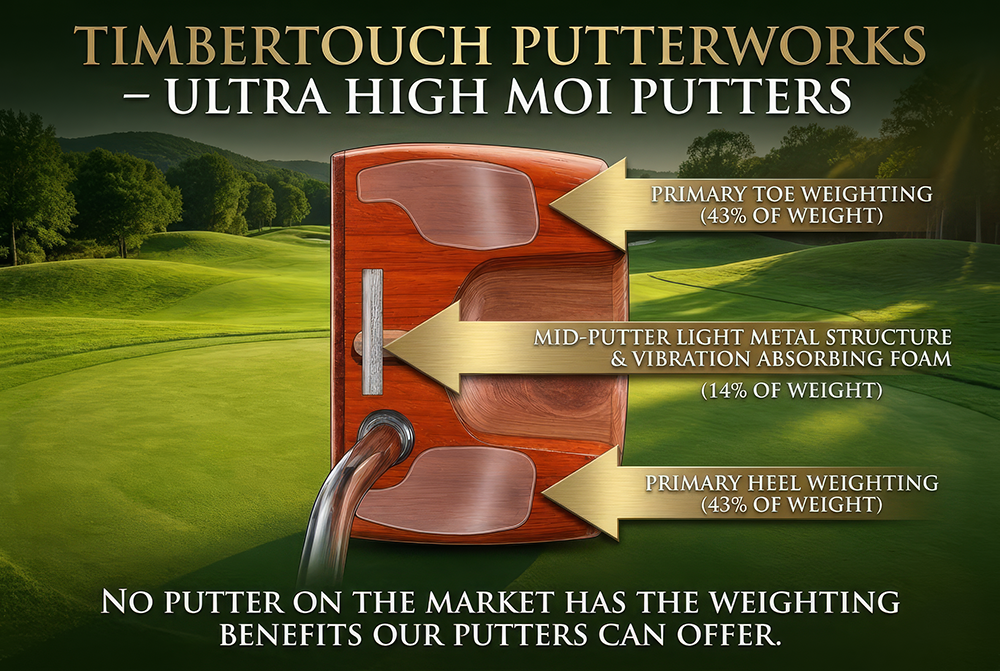
"High MOI" is on every putter box in the golf aisle. What almost nobody explains is how you actually get it — and in a wood putter, you can't just pour tungsten into a casting. Here's how MOI really gets engineered into a putter, from a maker who models it before cutting a single board.

Signature Design · The Wild Side FATTY
Wild Side FATTY — Canarywood, Zero Torque
$310 — streaked golden Canarywood over a full mallet footprint
CNC-machined to exact tolerances, hand-finished in the shop — and ready for your custom engraving on the top and sole (+$40 at checkout).
Design Yours → Add to CartWhat MOI Actually Is (In One Minute)
Moment of inertia is resistance to twisting. When you strike a putt off-center, the ball pushes the face backward at the contact point — and the head wants to rotate around its center of gravity. The more of the head's mass that sits far from that center, the harder it is to twist. That's it. High MOI means off-center hits twist the face less, so the ball starts closer to your line and loses less speed.
That last part is the one golfers feel most: mishits on a high-MOI putter still roll out near your intended distance. Three-putts usually start with a first putt that came up short off the toe.
Step 1: Model It Before You Build It
Every TimberTouch head shape starts as a CAD model, and I run MOI calculations on the design before anything gets machined — tweaking the outline, wall positions, and weight placement in software until the numbers are where I want them. Wood is lighter than steel, which sounds like a disadvantage. It's actually the opportunity.
Step 2: Use Wood's Lightness to Your Advantage
Because a wood body is light, a large share of the target head weight — typically 340 to 370 grams in our builds — is left over for me to position deliberately. That budget goes into hidden lead weights, poured into CNC-machined pockets pushed as far to the outside corners of the head as the design allows. Far-outside weighting is the whole game: the same gram of mass contributes far more MOI at the perimeter than it does in the middle.
A steel putter's body eats most of its own weight budget in the middle of the head. A wood putter lets me spend that budget at the edges, which is why a well-designed wood mallet gives up nothing in forgiveness — and why our largest heads are among the most stable putters you can play.
Step 3: Lock It In
The poured lead is locked into its pockets permanently, then the head is closed with wood skins — which is why you can't see any of this on the finished club. What you see is furniture-grade joinery; what you feel is a face that refuses to twist. The critical surfaces — face, sole, weight pockets — are all CNC-machined so weight placement is repeatable putter to putter.
The face itself gets one more engineered detail: we laser engrave the strike area to a consistent, chosen depth, so the face grips the ball at impact and starts it rolling sooner instead of skidding.
If you want to feel what far-outside weighting does, our Woodrich Regal is the highest-MOI head we build — that's the one to try first.
MOI FAQ
Does higher MOI make you a better putter?
It makes your bad putts better. MOI doesn't aim the club for you — it reduces how much an off-center strike twists the face, so mishits start closer to your line and finish closer to your distance.
Can a wood putter really match steel for MOI?
Yes — because wood's light body frees up weight to place at the extreme perimeter, where each gram contributes the most MOI. It's a design advantage, not a compromise.
Is a bigger head always higher MOI?
Generally, more footprint allows weight to sit farther out — but only if the design actually puts it there. Weight placement matters more than size alone.
From the Shop
Pick Your Putter — Every One Can Be Engraved


Add custom engraving to any putter for $40 — just select the option on the product page.
The Bottom Line
MOI isn't marketing — it's mass placement, and it's measurable before the first cut. We design it in software, machine it in wood, and lock it in lead. The beauty on top is just how we like to finish the math.
Make Your Mark on the Green
Every TimberTouch putter is designed in CAD, CNC-machined to exact tolerances, and hand-finished. Pick yours and we'll engrave your story into it.
Shop All Putters →First Look at New One-of-a-Kind Builds
Many of our putters are one of a kind — when they're gone, they're gone. Join the list and see new builds and engraving ideas before anyone else.
Share:
Exotic Wood Putters: What Each Wood Actually Brings to the Roll
The History of Wood Putters: 400 Years Before Steel Took Over