

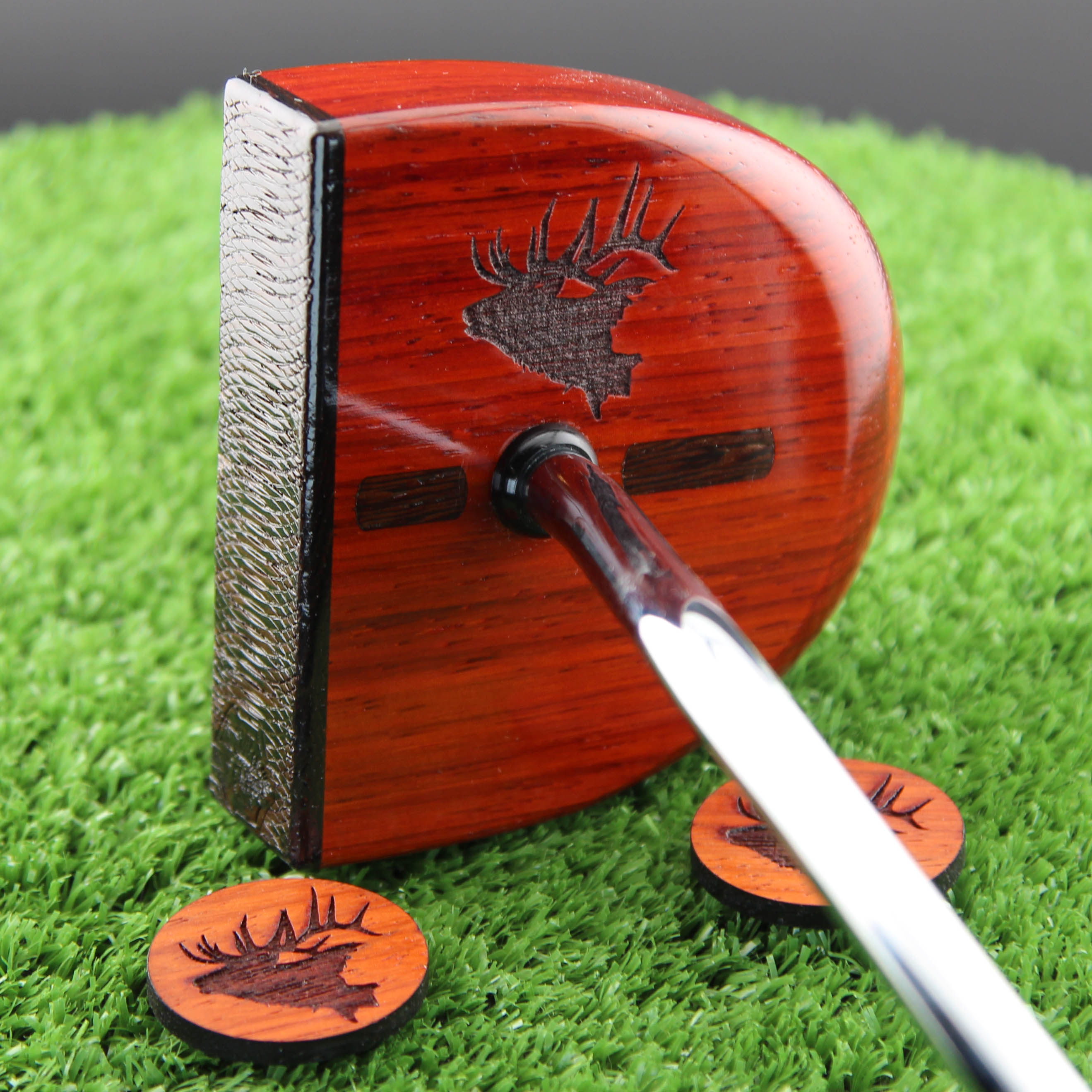
On my bench right now there's a plank of Padauk the color of a sunset and a length of Zebrawood striped like its namesake. Before either becomes a putter, I spend more time choosing and pairing woods than most people would guess. An exotic wood putter isn't a metal head dressed up in a pretty veneer — the wood is the club, and the species I pick changes how it looks, how it sounds, and how it rolls the ball.

Signature Design · The Tuxedo
Tuxedo — Multi-Wood Zero-Torque Woodrich Regal
$310 — five exotic woods layered into one head
CNC-machined to exact tolerances, hand-finished in the shop — and ready for your custom engraving on the top and sole (+$40 at checkout).
Design Yours → Add to CartMost guides about wooden putters stop at "they feel soft and look cool." I want to go a layer deeper, because I cut and shape these woods every week. Here's what each one actually brings to a putter, and why I reach for certain species over others.
Why I Build Exotic Wood Putters in the First Place
Steel and aluminum are consistent, and that's exactly why they feel the same in everyone's hands. Wood is the opposite. Each species has its own density, grain, and tone, so an exotic wood putter can be tuned — by the maker, not a factory — for the exact feel a golfer is after.
Denser tropical hardwoods give a firmer, more clicky strike and a lively roll. Softer, more open-grained woods absorb a touch more impact and feel buttery on short putts. When I layer several species into one head, I'm blending those characteristics on purpose. That's the whole point of building by hand.
The Woods I Reach For — and What Each One Does
No two of my one-of-a-kind builds use the exact same recipe, but a handful of woods show up again and again. Here's how they behave under the belly of a putter.
Padauk
Padauk is my go-to when a golfer wants feedback. It's a dense, tough tropical hardwood — the same qualities that make it a favorite for musical instruments give a putter a crisp, musical strike and a clean sound off the face. Fresh-cut it's a fiery orange-red that deepens to a rich brown over time. It hits firm but never harsh.
Wenge
Wenge is nearly black, with fine straight grain and real heft. I use it when I want a putter to feel planted and to look serious. As an inlay it draws a clean dark line through lighter woods; as a body wood it adds mass low in the head, which helps stability.
Zebrawood
Zebrawood earns its name — bold, alternating light-and-dark stripes that make a head impossible to mistake for anyone else's. It's a striking wood with a medium-firm feel, and it's one of the most-requested looks I build. Paired with a darker body it practically glows in the sun.
Rosewood, Bubinga and Leopardwood
These are the show-stoppers. Rosewood runs from chocolate to deep purple-brown with a smooth, dense feel. Bubinga carries a red-brown figure that can look almost quilted. Leopardwood is flecked with the little "eyes" of its ray fleck, so it never sits flat in the light. They're dense enough to putt beautifully and dramatic enough that no two boards are alike.
Canarywood, Cedar and Walnut
Not every wood in a build is there to be loud. Canarywood adds a warm yellow-to-rose streak. Cedar is light and aromatic, useful for balancing weight in a bigger head. Walnut is my steady, even-tempered wood — classic brown, forgiving to work, and a great backbone for a layered body. These are the woods that make the flashy species look even better.
How Layering Exotic Woods Changes the Feel
Here's where hand-building matters most. When I stack Padauk over Wenge over Walnut, I'm not just making stripes — I'm deciding where the mass sits and how the face responds. A firmer face wood over a denser body reads as a lively, honest roll; a softer face over a heavy body feels muted and planted. I can move the balance point around by choosing which wood goes where.
That's why every one of these putters is genuinely one of a kind. If you want to see how different the same idea can look across a dozen builds, my Specialty and One-of-a-Kind putters collection is where the boldest wood pairings end up — each one photographed as the single putter you'd actually receive.
Do Exotic Wood Putters Hold Up on the Course?
This is the honest question every buyer asks, so here's the honest answer. A wooden putter is fully legal for tournament play as long as it meets the standard rules on club and face dimensions (Source: USGA). Mine are built to conform.
Durability comes down to the build, not the material. I seal every head against moisture so a little dew or rain won't hurt it, and dense hardwoods like Padauk, Wenge and Rosewood are hard-wearing by nature. Treat one like the nice club it is — wipe it down, keep a headcover on it — and it'll outlast plenty of the metal putters that get tossed in a trunk.
From the Shop
Pick Your Putter — Every One Can Be Engraved


Add custom engraving to any putter for $40 — just select the option on the product page.
Exotic Wood Putter FAQ
Are exotic wood putters legal for tournament play?
Yes. A wooden putter is legal as long as it conforms to the same rules that govern any putter — length and clubhead dimensions among them (Source: USGA). Every putter I build is made to conform, so you can game it in a club event without a second thought.
What's the best exotic wood for a putter?
There's no single best — it depends on the feel you want. Padauk and other dense tropicals give crisp feedback and a firmer sound; softer or more open-grained woods feel more muted and forgiving on short putts. That's exactly why I pair several species in one head.
Do wood putters feel softer than metal?
Generally, yes. Wood absorbs a bit more of the impact than steel, so most golfers describe the feel as softer and the sound as warmer — especially welcome on short and mid-range putts where touch matters most.
Are exotic wood putters only for show?
No. They're built as playing tools first. The looks are real, but so is the engineered weighting, the sealed and finished face, and the roll. A beautiful putter that couldn't putt would be a failure on my bench.
How do I take care of a wooden putter?
Wipe it dry after a wet round, keep the headcover on between holes and in the bag, and store it out of extreme heat. That's really it — the finish does the hard work.
Choosing Your Own
An exotic wood putter is one of the few clubs in the bag you get to choose for feel and character in equal measure. Start with the roll you want — crisp and lively, or soft and planted — and let that steer the woods. From there it's about the piece that catches your eye, because you'll be looking down at it on every green.
If a particular pairing speaks to you, or you have woods in mind for a build of your own, reach out and I'll walk you through it. Every putter I make starts exactly this way — with someone standing at the bench, choosing.
Make Your Mark on the Green
Every TimberTouch putter is designed in CAD, CNC-machined to exact tolerances, and hand-finished. Pick yours and we'll engrave your story into it.
Shop All Putters →First Look at New One-of-a-Kind Builds
Many of our putters are one of a kind — when they're gone, they're gone. Join the list and see new builds and engraving ideas before anyone else.
Share:
The Sound of a Putt: Why Feel Is Mostly Hearing (And Wood Sounds Right)
How We Engineer High MOI Into a Wood Putter (The Real Process)