

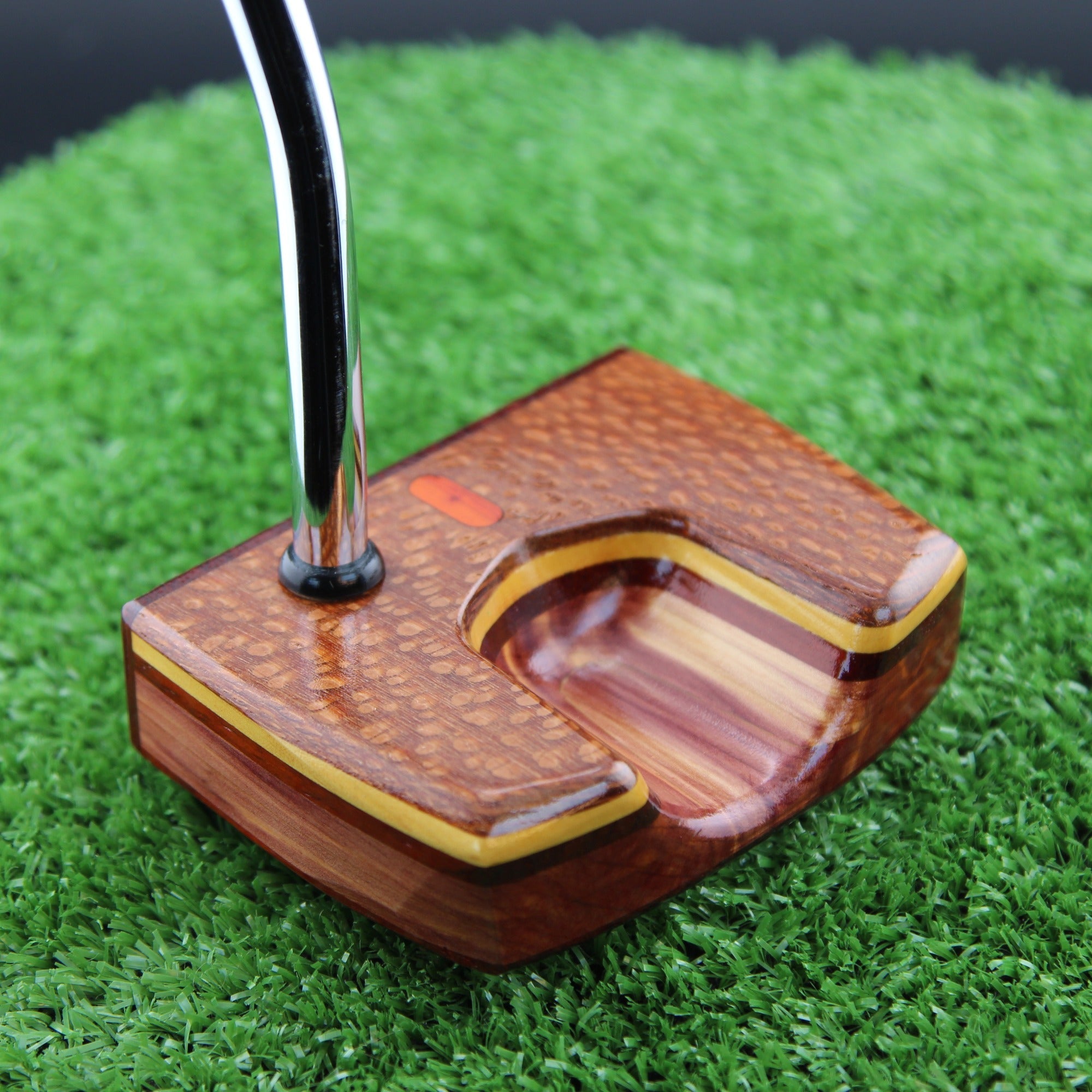
The history of wood putters is longer than the history of golf balls that bounce. For roughly four centuries — from the earliest days of golf on the Scottish links until steel swept the game in the early 1900s — every putter that ever rolled a ball toward a hole was made of wood. I build wood putters for a living, designed in CAD and CNC-machined to tolerances the old Scottish makers could only dream about, so this history isn't trivia to me. It's the family tree.
The Long-Nose Era: When Every Putter Was a Wood Putter
The earliest putters we know much about are the “long-nose” clubs of the 1600s, 1700s, and early 1800s. The name is literal — the heads were long, slender, and shallow, often six inches or more from heel to toe, hand-shaped from tough hardwoods like beech and fruitwoods, with shafts of ash or hickory and grips of soft sheepskin. A golfer of the era carried a small set of these wooden clubs, and one of them was always the putter — putting was simply another job for a wooden head.
These weren't crude sticks. The best long-nose clubs were graceful, carefully weighted instruments, and the putter was often the most refined club in the bag because the short game demanded the most precision.
Hugh Philp and the McEwans: The First Great Putter Makers
Two names tower over this era. Hugh Philp of St Andrews made long-nose clubs from 1819 to 1855, and since his death in 1856 he has been recognized as clubmaking's finest artisan — an original Philp putter is regarded as the Stradivarius of golf clubs, so sought after that forgers copied his work almost immediately (Source: St Andrews Golf Co.). In Edinburgh, the McEwan family ran a clubmaking dynasty founded by James McEwan in 1770 and passed father to son for four generations, specializing in long-nose clubs (Source: hickoryclubs.eu).
What strikes me most about Philp and the McEwans is that their reputations were built on the same things mine depends on: wood selection, weighting, balance, and finish. The tools changed. The judgment didn't.
The Gutty Ball Changes Everything
In 1848 the gutta-percha ball — the “gutty” — replaced the old feather-stuffed leather ball. It was cheaper, more durable, and much harder, and it beat the delicate long-nose heads to pieces. Clubmakers responded by making heads shorter, deeper, and stouter (Source: hickoryclubs.eu). Putters followed the same path: the elegant long-nose putter gradually gave way to shorter, more compact wooden heads, and makers began reinforcing faces with inserts of leather, horn, or bone and pouring lead into the back for weight — the first face inserts and the first perimeter weighting in golf.
That's worth pausing on: face inserts and rear weighting, the two ideas every modern putter company markets as technology, were invented by wood putter makers responding to a ball change 175 years ago.
Steel Arrives, Wood Retreats
Through the late 1800s, iron-headed putters gained ground, and after steel shafts were legalized in the 1920s the transformation was complete. Wooden-headed clubs were still handmade by local professionals until around 1910, when factories took over (Source: Golf Club Revue). Within a generation, the wood putter went from the standard to a curiosity. Persimmon held on in drivers and fairway woods until the 1980s, but on the greens, steel and later milled aluminum ruled almost completely.
Almost. The wood putter never actually disappeared — it became rare, which is a different thing. The USGA rules never banned wood heads; they simply stopped being mass-produced, because wood demands hand work that factories don't want to do.
The Modern Revival: Old Material, New Engineering
This is where my shop picks up the story. A modern wood putter isn't a replica of a long-nose club — it's what Philp might have built with today's tools. I design every head in high-level CAD, combine exotic hardwoods of different densities — wenge, rosewood, purpleheart, canarywood — to place weight exactly where the MOI math wants it, CNC-machine the head to exact tolerances, and then hand-finish it the way the old makers finished theirs. The result conforms to the Rules of Golf and putts like a modern high-MOI mallet, but it carries four hundred years of lineage in its grain.
Frequently Asked Questions
When were wood putters first used?
Wood putters date to the earliest centuries of golf in Scotland. From the 1600s through the mid-1800s, long-nose wooden putters with beech or fruitwood heads and ash or hickory shafts were the standard putting club — every golfer's putter was made of wood.
Are wood putters legal under the Rules of Golf today?
Yes. The rules govern a putter's dimensions, features, and performance, not its head material. A well-made wood putter conforms just as a steel or aluminum one does.
Who was the most famous wood putter maker in history?
Hugh Philp of St Andrews (1819–1855). His long-nose putters are considered the finest of the era — collectors call an original Philp the Stradivarius of golf clubs.
Why did golf move away from wood putters?
Industrialization more than performance. Iron and steel heads could be mass-produced cheaply after about 1910, while wood demands individual selection, shaping, and finishing.
How is a modern wood putter different from an antique one?
Design and precision. Antique putters were shaped by eye and hand plane. A modern build is designed in CAD, CNC-machined to exact tolerances, and engineered with multiple wood densities for high MOI — then hand-finished, which is the one step that hasn't changed.
The Bottom Line
For most of golf's history, putting a wooden head on the ball wasn't a novelty — it was the game. If the lineage of Philp and the McEwans appeals to you, the good news is you don't have to bid at an antique auction to putt with wood. You just need a maker who takes the old material as seriously as the old masters did, with tools they never had.
Share:
How We Engineer High MOI Into a Wood Putter (The Real Process)
Walnut Putters: The Quiet Backbone of Every Exotic Wood Build