

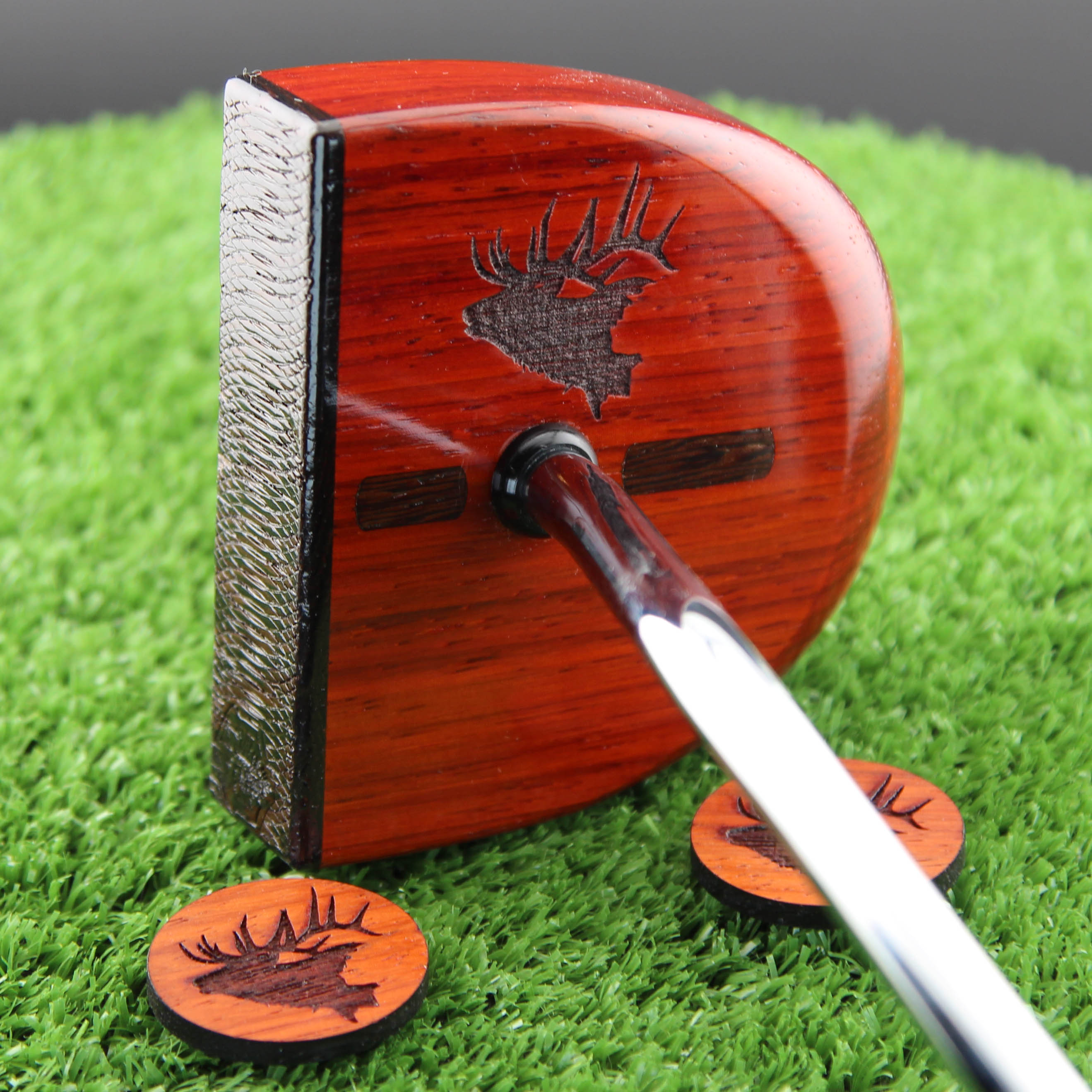
Zero torque putters went from a curiosity to a full category in about two seasons. Today's Golfer's 2026 buying test alone covered 37 zero-torque models. Almost everything written about them comes from people who test putters. I build them, which means I spend my time on the part nobody photographs: where the mass actually sits inside a head, and how the shaft axis has to run to meet it.
So here is the version from the bench. What a zero torque putter really does, who it genuinely helps, the trade-off that never makes the marketing copy, and why balancing one out of layered hardwood is a different engineering problem than milling one from a billet of steel.

Signature Design · The Tuxedo
The Tuxedo — Center Shaft, Zero Torque
$310 — rosewood and tigerwood layered over a center-shaft build
CNC-machined to exact tolerances, hand-finished in the shop — and ready for your custom engraving on the top and sole (+$40 at checkout).
Design Yours → Add to CartWhat a zero torque putter actually is
Torque, in a putter, is the twisting force the head generates around the shaft during the stroke. Hold a conventional putter by the grip and let it hang: the toe drops. That is the head's center of gravity sitting off the shaft axis, and in a stroke it is what makes the face want to open going back and close coming through.
A zero torque putter moves the shaft axis so it runs through — or very near — the head's center of gravity. With the mass balanced on that axis, there is almost nothing for the head to twist around. The face stays square to the path instead of rotating open and shut on its own.
Nearly every zero torque design ends up center shafted for exactly this reason. The shaft has to enter somewhere near the middle of the head to line up with the balance point, which is why these putters look the way they do at address.
Why zero torque putters are suddenly everywhere
Two things happened at once. Every major manufacturer added a zero torque line, and tour players started switching — not for feel, but because it is easier to start putts on line with a face that will not rotate on its own. When a technology gets both shelf space and tour validation in the same season, it stops being niche.
That does not mean it is right for every golfer. It means the option is finally easy to find.
Who a zero torque putter actually helps
Zero torque suits a golfer whose stroke is already close to straight back and straight through, or one who is actively fighting to stop manipulating the face through impact (Source: Today's Golfer). If your natural motion has a real arc in it with genuine face rotation, a head that refuses to rotate will fight you. You end up steering it.
The clearest gains show up inside ten feet, where start line matters more than speed control and a square face at impact is most of the job.
The honest counterweight comes from MyGolfSpy, and it is worth repeating: most amateurs miss their start line because of aim and setup, not because the face rotated. A zero torque head cannot fix an aim problem. If you are set up pointing left, it will send the ball left with tremendous consistency.
The trade-off nobody puts on the box
The most consistent criticism from players who have switched is that a zero torque putter can feel empty through the stroke. With no torque, there is less feedback telling your hands what the head is doing. Some golfers find that calming. Others find it disorienting for a few rounds and a few never make peace with it.
This is where material matters more than the marketing suggests. A face of dense exotic hardwood returns a softer, lower-pitched contact than milled steel, and the difference between a center strike and a heel strike is audible. That sound is feedback the balance took away, handed back through the material instead of the geometry.
It is the reason our zero torque center shaft putters sit in their own group rather than as a footnote on the rest of the line. Those are the builds where feel had to be engineered back in deliberately, not assumed, and the woods are chosen partly for how they sound at contact. Every one of them is a true center shaft with the balance point machined to the shaft axis.
Building zero torque into wood is a different engineering problem
Steel is dense and predictable. Layered exotic hardwood is neither. Padauk, wenge, walnut, and cedar all carry different densities, and a head built from five of them has its center of gravity somewhere that depends entirely on how those layers are stacked and where the internal weighting sits.
So the center of gravity gets solved in CAD before anything is cut. We model the stack, place the weighting, and locate the shaft bore so the axis meets the balance point — then the head is CNC-machined to those tolerances and hand-finished. On a wood putter you do not discover the balance afterward. Change the layup and the geometry changes with it.
That constraint is also why a zero torque wood putter cannot be an improvisation at the bench. It has to be right in the model first, which is precisely the part of the work that never shows up in a photograph.
How to tell if a zero torque putter is right for you
Before you spend the money, five quick checks:
- Film your stroke from above. Straight back and through, or a noticeable arc? Straight favors zero torque; a pronounced arc usually does not.
- Check your aim before your face rotation. Lay a club on the ground and see where you actually point. Fix that first, because no putter design compensates for it.
- Look at where your misses go. Pushes and pulls from short range point toward a face-control issue. Poor distance control does not.
- Set one down behind the ball. The center-shaft look is what most golfers bounce off, and you will know within thirty seconds.
- Get the length and lie right regardless. A badly fitted zero torque putter is still a badly fitted putter.
From the Shop
Pick Your Putter — Every One Can Be Engraved


Add custom engraving to any putter for $40 — just select the option on the product page.
Zero torque putter FAQ
What is a zero torque putter?
A zero torque putter is one whose shaft axis passes through the head's center of gravity, so the head has almost no tendency to twist during the stroke and the face stays square to the path (Source: Golf Monthly). Most are center shafted, because that is where the shaft has to enter the head to meet the balance point.
Do zero torque putters actually help you make more putts?
For the right golfer, yes — testing has shown tighter start-line consistency, particularly on off-center strikes (Source: Today's Golfer). For a golfer whose real problem is aim, setup, or speed control, the design has nothing to offer (Source: MyGolfSpy).
Are zero torque putters good for beginners?
They can be, because a face that resists rotation removes one variable while you are still building a repeatable stroke. The catch is that a new player often has not settled into a stroke shape yet, so a proper fitting for length and lie will do more for their scores than the balance design will.
Can a wood putter be zero torque?
Yes, but it has to be designed that way from the model outward. Because layered hardwoods vary in density, the center of gravity depends on the exact stack, so the weighting and shaft bore are solved in CAD and then machined to that geometry rather than adjusted at the bench.
Is a zero torque putter legal for tournament play?
Zero torque models are sold by major manufacturers and played at tour level (Source: GolfWRX). If you are buying a custom build rather than an off-the-shelf model, ask the maker to confirm it conforms before you put it in play in a competition.
Making the call
If your stroke already runs straight back and straight through, or you know your hands get busy through impact, a zero torque putter is worth a serious look — and worth putting behind a ball before you buy, because the address view is where most golfers decide.
If you have a real arc and you like feeling the head work, you will probably spend a season fighting it. There is no shame in that. The best putter in your bag is the one that lets you stop thinking about the putter.
And whichever way you land, get the length and lie right first. That is the fitting that changes scores.
Make Your Mark on the Green
See which TimberTouch builds are true center shaft, zero torque — and which body style suits your stroke. Every putter is designed in CAD, CNC-machined to exact tolerances, and hand-finished.
Browse Zero Torque Putters →First Look at New One-of-a-Kind Builds
Many of our putters are one of a kind — when they're gone, they're gone. Join the list and see new builds and engraving ideas before anyone else.
Share:
Zebrawood Putters: The Striped African Hardwood That Turns Heads
Putter Fitting at Home: Length, Weight, and Style in 10 Minutes