

Stand over a putt anywhere in the world and you're aiming at a hole exactly 4.25 inches across. Not 4, not 4.5 — 4.25. So why is a golf hole 4.25 inches? The honest answer: nobody designed it. A piece of drainpipe in a Scottish fishing town happened to be that size, and golf has lived with it ever since. As a shop that machines putters to thousandths of an inch, we find that endlessly entertaining — the most precise target in sports was set by scrap plumbing. Here's the story of the hole, the ball, and the other standards golfers take for granted.

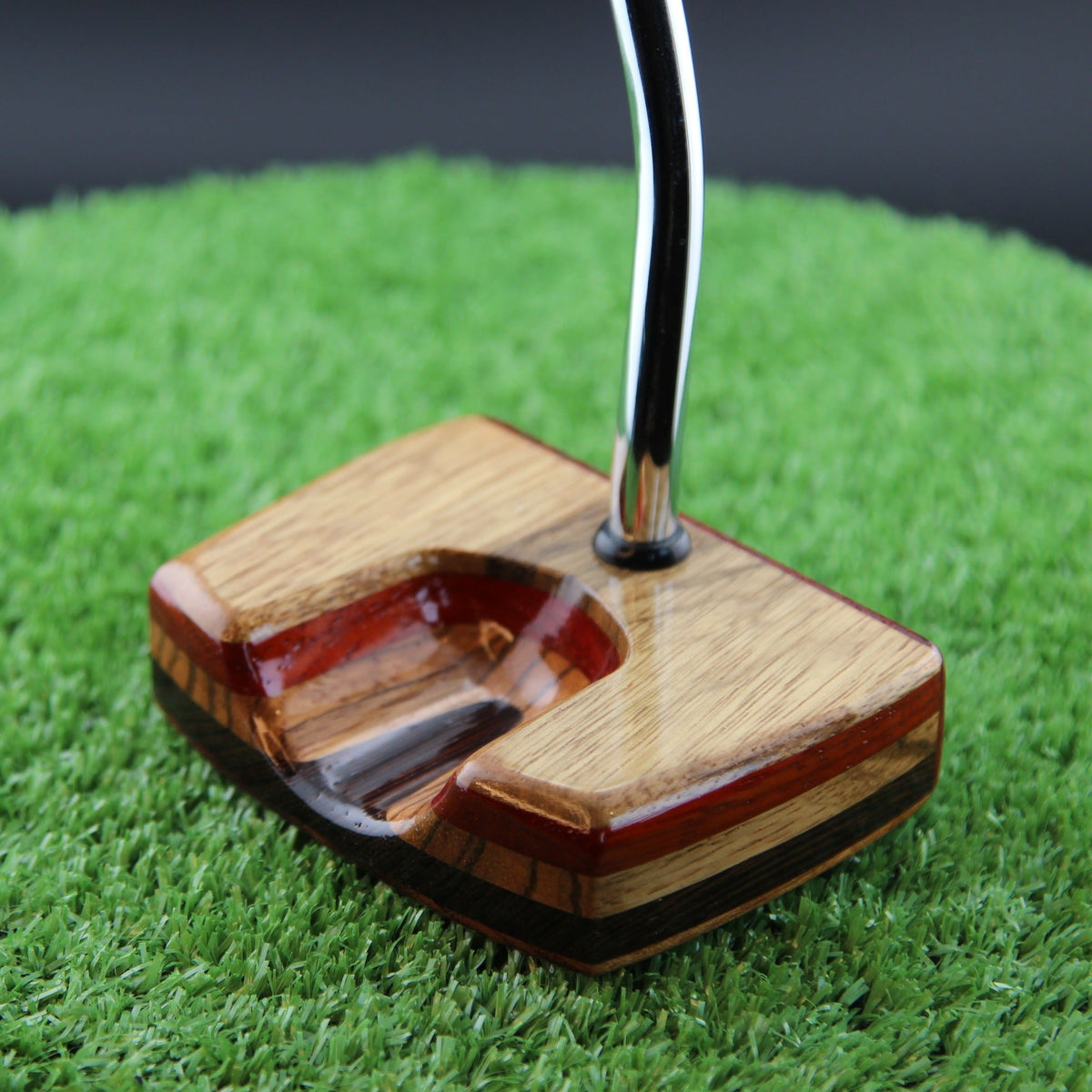
Signature Design · The Korina
White Limba & Padauk Zero Torque Woodrich Regal
$290 — golf's newest tradition, built the old way
CNC-machined to exact tolerances, hand-finished in our shop — and ready for your custom engraving on the top and sole (+$40 at checkout).
Design Yours → Add to CartThe hole: a drainpipe in Musselburgh
For golf's first few centuries there was no standard hole at all. Holes were cut by hand with knives and trowels, so they varied from course to course — and often from hole to hole on the same course, getting wider all day as sand was scooped out for teeing.
Around 1825, clubs started dropping liners into the ground to keep the edges from crumbling. The liner at Musselburgh, east of Edinburgh, was famously a length of old drainpipe that happened to measure 4.25 inches across. Golfers there got used to it, and when the club had a blacksmith build the first known purpose-made hole cutter in 1829, it was made to match the pipe. (Source: Golf Monthly)
Other clubs did their own thing — Royal Aberdeen reportedly cut six-inch holes — but when the R&A wrote a unified set of rules in 1891, it needed one number and took Musselburgh's. The drainpipe won. Today the rules still call for a hole 4.25 inches in diameter and at least 4 inches deep, everywhere golf is played.
The ball: three revolutions and a 30-year argument
The ball took longer to settle. The earliest balls were featheries — leather pouches stuffed with boiled goose feathers, stitched and painted by hand. A skilled maker could finish only a few per day, so a ball could cost more than a club.
In 1848 the guttie arrived: molded gutta-percha sap, cheap enough that ordinary people could afford to play. Around the turn of the century the rubber-wound Haskell ball replaced it, flew farther, and forced the first real conversation about limits.
In 1921 the R&A and USGA agreed on a ball of at least 1.62 inches in diameter and no more than 1.62 ounces. Then they stopped agreeing. In the early 1930s the USGA moved America to a larger 1.68-inch ball, while Britain kept the small one — and for roughly half a century golf was played with two different legal balls. The small "British ball" flew farther and bored through wind better, so American pros routinely switched to it at The Open. The R&A required the 1.68-inch ball at The Open starting in 1974 and finally eliminated the small ball in 1990. (Source: USGA)
Today's ball — minimum 1.68 inches, maximum 1.62 ounces (45.93 grams) — is the compromise left standing after that argument. Like the hole, it wasn't designed from first principles. It was negotiated.
Fourteen clubs, one overloaded caddie
Until the late 1930s you could carry as many clubs as your caddie could shoulder, and top players pushed that hard — some carried 25 or more, including multiple lefty and righty spares. Caddies suffered, and the governing bodies decided skill should matter more than inventory. The USGA capped the bag at 14 clubs in 1938 and the R&A followed in 1939. (Source: USGA)
Why exactly 14? It roughly matched a full classic set of the day — and it forced a choice that still shapes the game: every club has to earn its spot. We like that rule for obvious reasons. When one of the fourteen is a putter you chose because of how it feels, looks, and rolls, it's the club you'll use on more strokes than any other.
The stymie, and other rules that didn't survive
Not every tradition made it. Under the old stymie rule, if your opponent's ball sat between yours and the hole in match play, it stayed there — you putted around it or chipped over it. The joint 1952 R&A/USGA rules abolished it, and golf's most infuriating chess move disappeared. (Source: USGA)
The pattern across all of these is the same: golf's standards weren't handed down complete. They were shaped by craftsmen, accidents, and long arguments — a blacksmith's hole cutter, a ball maker's new material, a caddie's aching back.
What this history means at our bench
We build putters inside rules that started as happenstance, and we think that's the best part of the story. The specs are fixed — the hole is 4.25 inches, the ball is 1.68 — but how you get the ball to that hole is still wide open, and it's still craftsman's territory.
That's the tradition we work in. Every TimberTouch putter starts in CAD, gets CNC-machined from layered exotic hardwoods to exact tolerances, and is finished by hand — the same marriage of precision and craft that gave golf its standards in the first place. Our Korina model, for example, pairs pale White Limba with flame-orange Padauk around a zero-torque center shaft: a head built to keep the face square and the roll pure on its way to that 4.25-inch target.
Common questions
Why is a golf hole 4.25 inches in diameter?
Because the hole liner at Musselburgh, Scotland — reportedly a section of drainpipe — happened to measure 4.25 inches, and the club's 1829 hole cutter copied it. When the R&A standardized the rules in 1891, it adopted that size, and it has been the worldwide standard ever since.
Are all golf balls the same size?
Now, yes: a conforming ball must be at least 1.68 inches in diameter and no more than 1.62 ounces. But from the early 1930s until 1990, Britain and America played different legal balls — the smaller 1.62-inch "British ball" flew farther and wasn't fully retired until 1990.
Why can I only carry 14 clubs?
Players in the 1930s were carrying 25 or more clubs, and the governing bodies decided the game should test skill, not equipment volume — so the USGA set the 14-club limit in 1938, with the R&A following in 1939.
Are wooden putters legal under the rules?
Yes. The rules govern a club's dimensions and features, not its material — wood is where golf clubs began. Our putters are designed and machined to conform, so a layered exotic-wood putter is as tournament-legal as any milled steel head.
From the Shop
Pick Your Putter — Every One Can Be Engraved


Add custom engraving to any putter for $40 — just select the option on the product page.
The standards are set. The putter is yours.
Golf gives you a fixed target and a fixed ball, and leaves one great variable in your hands: the club you choose to finish the hole with. A century and a half after a Scottish drainpipe set the target, we think the most satisfying way to attack it is with a putter made of real wood, machined precisely, and made for you alone. History picked the hole size. You get to pick the putter.
Make Your Mark on the Green
Every TimberTouch putter is designed in CAD, CNC-machined to exact tolerances, and hand-finished. Pick yours and we'll engrave your story into it.
Shop All Putters →First Look at New One-of-a-Kind Builds
Many of our putters are one of a kind — when they're gone, they're gone. Join the list and see new builds and engraving ideas before anyone else.
Share:
Dew Sweepers: Why Wiping Dew Off Your Putting Line Costs You Two Strokes
The Best Golf Gift Isn't a Dozen Balls: Why a Wood Putter Wins