

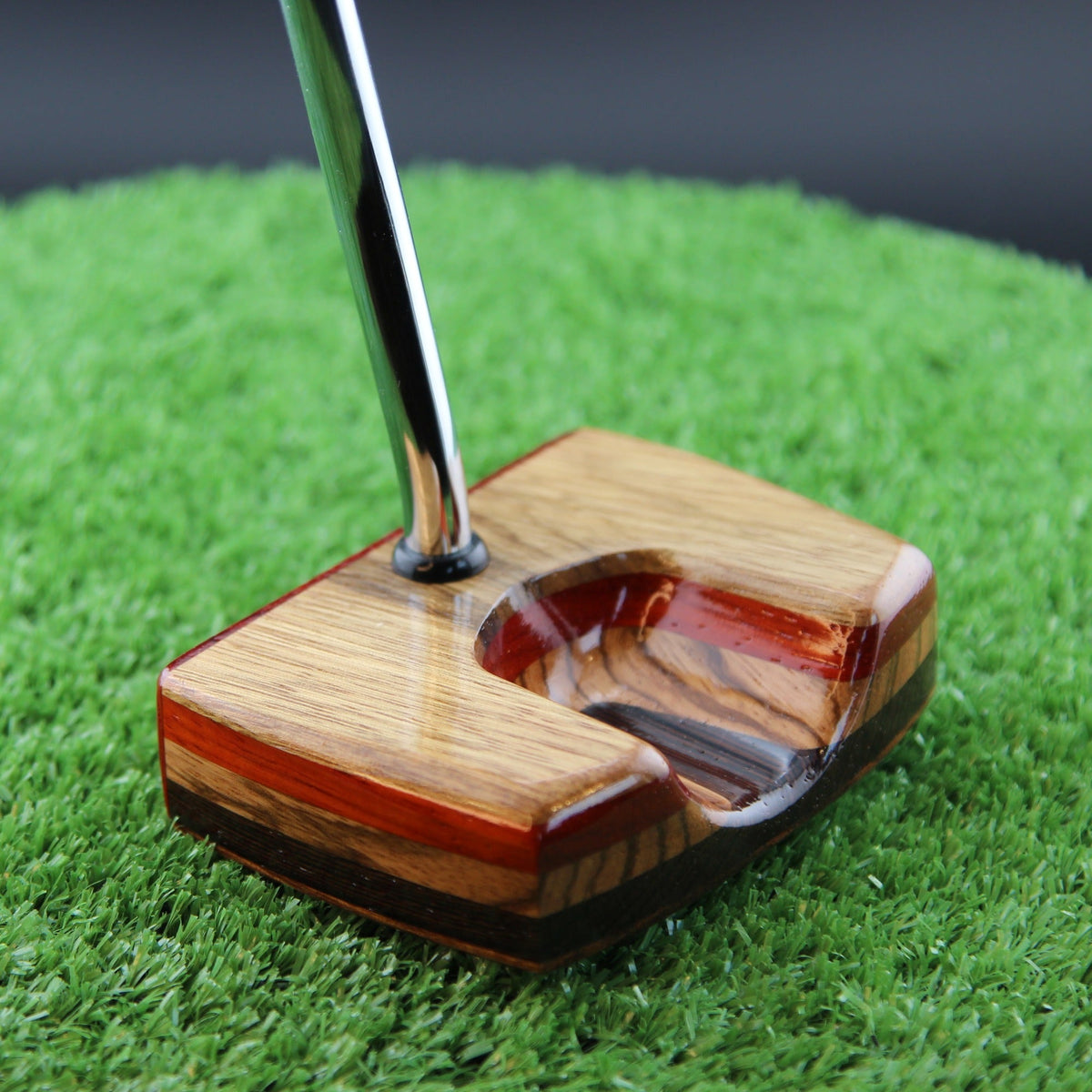
Our newest zero-torque build, the Korina, pairs a padauk face with a wood most golfers have never heard by name, even if they've seen it without knowing it: white limba. It's the same pale, straight-grained African hardwood that electric guitar makers have chased since the late 1950s under a different name entirely — korina — and it turns out to behave as well under a CNC bit as it does under a luthier's chisel. Here's what white limba actually is, how it differs from its darker sibling black limba, and why it earned a spot in one of our newest Woodrich Regal heads.

Signature Design · The Korina
Korina — White Limba & Padauk Woodrich Regal
$290 — white limba and padauk in one zero-torque head
CNC-machined to exact tolerances, hand-finished in our shop — and ready for your custom engraving on the top and sole (+$40 at checkout).
Design Yours → Add to CartWhat White Limba Actually Is (And How It Differs From Black Limba)
White limba comes from Terminalia superba, a hardwood tree native to tropical West Africa that grows 65 to 100 feet tall with a trunk 5 to 7 feet across (Source: The Wood Database). The heartwood runs light yellowish to golden brown, straight-grained with a uniformly coarse texture and a soft, even luster. When that same log comes out with grey-to-black streaking running through the grain, the wood gets sold as black limba — the wood behind our Black Limba wood guide. When the grain runs plain and pale with no streaking, it's called white limba. Same species, sometimes the same tree, different figuring.
On the Janka hardness scale, white limba comes in at 670 lbf — softer than wenge, rosewood, or padauk, and closer in feel to a hard walnut. It's also light: a dried board runs around 35 pounds per cubic foot, roughly half the density of some of the tropical hardwoods we build with most often. What white limba lacks in raw density it makes up for in workability. It has minimal silica content, so it doesn't dull tooling the way some tropical species do, and it takes glue and finish cleanly — which is exactly why it machines to a tight tolerance under CNC instead of chipping or tearing out at the edges.
Why Guitar Makers Call Limba "Korina"
If you've spent any time around vintage electric guitars, you've probably heard the name korina before you ever heard "limba." That's Gibson's doing. The company's original 1958 prototypes for the Flying V and Explorer were built from mahogany, and it was heavy — heavy enough that Gibson went looking for an alternative that kept a similar tonal character with less weight on a strap. Limba was the answer, and Gibson gave it the trade name korina so it would sound as distinctive on a spec sheet as the guitars themselves looked (Source: Wikipedia, Gibson Flying V). Fewer than 100 Flying Vs were built in that original 1958–59 run, and original korina examples now rank among the most valuable production guitars ever made, trading for well into six figures.
We didn't need a six-figure vintage guitar to notice what those luthiers noticed 65 years ago: a light, stable, easy-to-finish wood with real presence of its own, that doesn't need to borrow color or figure from anything else to look intentional.
Building the Korina: What White Limba Does in a Zero-Torque Head
Our Korina putter pairs a white limba body with a padauk face, laid out and balance-checked in CAD before either board ever meets the CNC. White limba's lower density gives us room to push more mass out toward the perimeter of the head without the putter creeping over target weight — exactly the kind of far-outside weighting a zero-torque Woodrich Regal is built around. The padauk face then brings the density, color contrast, and impact feel that white limba alone doesn't have on its own. It's a similar trade to the one Gibson made in 1958: swap in the lighter wood where weight matters, and let a second material carry what the lighter one can't. We just aimed it at a stroke instead of a guitar strap.
How a White Limba Putter Feels and Wears on the Green
An honest wood guide has to say the unflattering parts too. Raw limba is rated non-durable and more susceptible to insect attack than a dense tropical hardwood like wenge or bloodwood (Source: The Wood Database). That's a real property of the species — and a complete nonissue once it's part of a finished putter. Every TimberTouch head, white limba included, goes through multiple coats of the same marine-grade polymer sealant we build every putter with, the coating that lets our exotic wood putters handle wet mornings, dew, and the odd ding without ever opening the grain to moisture. The softness that would matter on an unfinished shelf turns into an advantage on our bench instead: it's part of why the wood cuts so cleanly to tolerance in the first place.
Limba also ambers with time and light exposure. The pale gold you see on a brand-new Korina head will deepen gradually over years on the course, the same slow patina a korina guitar body picks up over decades on stage. It's not a flaw to watch for — it's the wood doing what it's always done, just on a slower clock than the round you're playing today.
From the Shop
Pick Your Putter — Every One Can Be Engraved


Add custom engraving to any putter for $40 — just select the option on the product page.
White Limba Putter FAQ
What is white limba wood?
White limba is the plain, pale-grained heartwood of Terminalia superba, a hardwood tree native to tropical West Africa. It's the same wood guitar makers market under the trade name korina, prized for its light golden color, straight grain, and manageable weight.
What's the difference between white limba and black limba?
Both come from the same species, and sometimes the same log — the difference is figuring, not a different tree. Black limba shows grey-to-black streaks running through the grain; white limba is the plainer, unfigured wood without that streaking (Source: The Wood Database).
Why do guitar makers call limba "korina"?
Korina is a trade name Gibson invented in 1958 when it swapped the heavy mahogany bodies on its original Flying V and Explorer for lighter limba wood. The name stuck, and vintage korina guitars from that original run are now among the most valuable production guitars ever made (Source: Wikipedia, Gibson Flying V).
Is white limba durable enough for a golf putter?
On its own, limba is rated non-durable and can be vulnerable to insects in raw, unfinished form — a real property of the wood, not marketing spin. Sealed under the marine-grade, 2 part polymer finish every TimberTouch head gets, that softness stops being a liability; it's actually part of why the wood machines so cleanly to tight tolerances.
Does a white limba putter change color over time?
Yes. Like most limba, the pale gold heartwood ambers gradually with light exposure and handling, the same way a korina guitar body deepens over years on stage. It's a slow, natural patina, not a defect.
Should You Build Your Next Putter in White Limba?
White limba isn't the wood to reach for if you want the near-black density of wenge or the vivid red-orange of padauk carrying the whole head on its own — it's lighter, paler, and more understated by nature, and that's exactly the point of it. If a putter that machines light, holds a genuine zero-torque balance, and quietly ambers with age instead of just aging out sounds like your kind of build, the Korina is the one we'd point you to first. If you'd rather see that same balance philosophy in a different head style or a bolder wood pairing, the putters above cover both directions.
Make Your Mark on the Green
Every TimberTouch putter is designed in CAD, CNC-machined to exact tolerances, and hand-finished. Pick yours and we'll engrave your story into it.
Shop All Putters →First Look at New One-of-a-Kind Builds
Many of our putters are one of a kind — when they're gone, they're gone. Join the list and see new builds and engraving ideas before anyone else.
Share:
Scotland vs England vs Wales: A Golfer's Guide to the UK's Great Golf Regions