

Your rangefinder says 150. The flag sits 30 feet below your feet. If you fly a stock 150-yard club at that pin, you're long — maybe over the green — because the number on the screen isn't the number the shot plays. Rangefinder slope math is one of the most practical bits of physics in golf, and once you understand it you'll never blame the wrong thing for a long miss again. Here's what the laser actually measures, the simple arithmetic behind uphill and downhill shots, and how wind and air density quietly move the number further.

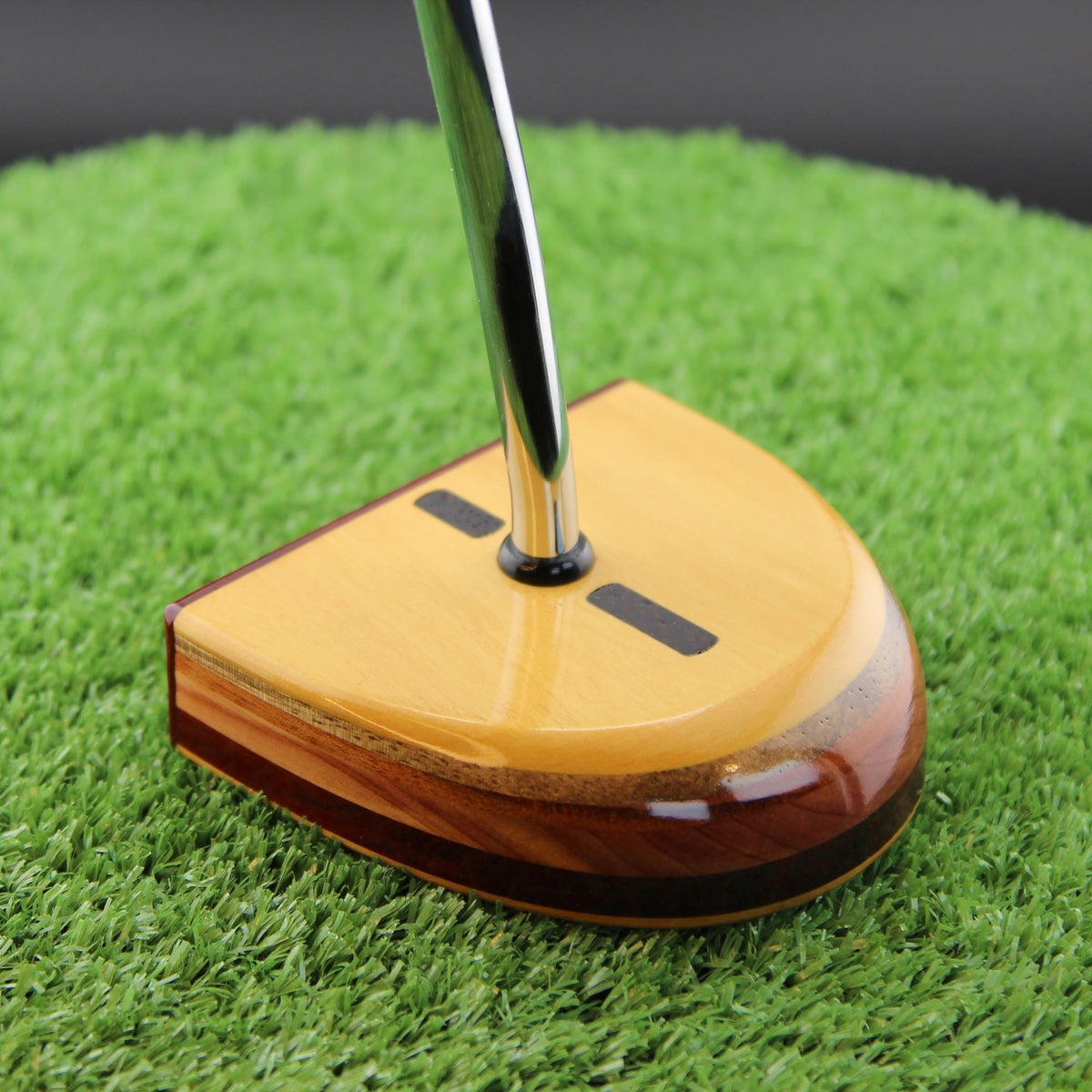
Signature Design · The Amarillo
Yellowheart & Padauk Zero Torque FATTY
$305 — golden Yellowheart, engineered roll
CNC-machined to exact tolerances, hand-finished in our shop — and ready for your custom engraving on the top and sole (+$40 at checkout).
Design Yours → Add to CartWhat the laser actually measures
A rangefinder measures the straight line from your eye to the flag — the slant distance. When the target sits above or below you, that line is the hypotenuse of a triangle, not the distance your shot effectively plays. The ball doesn't care about the hypotenuse; it cares about how far it must travel before its descending arc reaches the height of the green.
On a downhill shot, the ball keeps falling past the height where it would normally land, so it travels extra yards before touching down: the shot plays shorter than the laser number. Uphill, the green rises up to intercept the ball earlier in its arc: the shot plays longer. As a shop that lives in CAD all day, we'd call it the same lesson we apply to putter geometry — the number you measure is only useful if you measure the thing that actually matters.
The working math: your 150-yard shot that plays 138
The rule of thumb used by slope rangefinders and caddies alike: convert the elevation change to yards and adjust roughly yard-for-yard for a mid-iron trajectory. Thirty feet is 10 yards. So a 150-yard shot dropping 30 feet plays in the neighborhood of 138–140 yards — the laser's 150 minus the 10 yards of drop, and a touch more because a downhill ball lands on a shallower angle and releases forward. (Source: Blue Tees Golf)
Uphill is slightly crueler than downhill is kind. The same 30 feet uphill plays about 161–163, because the rising ground catches the ball on its way up or at peak, where it still has forward speed to lose. A practical table for a mid iron:
| Laser says 150, elevation change | Plays about |
|---|---|
| 30 ft downhill | 138–140 yards |
| 15 ft downhill | 144–145 yards |
| Flat | 150 yards |
| 15 ft uphill | 155–156 yards |
| 30 ft uphill | 161–163 yards |
Two caveats. Trajectory matters: a high-flying wedge is affected less per foot of elevation than a flat-flighted long iron, because its steep descent gives elevation less time to act. And the adjustment isn't perfectly symmetrical — uphill usually adds a bit more than the same drop subtracts.
Wind and air: the adjustments the laser can't see
Elevation is only the start. Wind is the biggest number-mover in golf: a common playing rule is that a headwind costs roughly 1% of carry per mile per hour, while a tailwind gives back only about half that. A 10 mph headwind turns your 150 into a 165; the same wind behind you makes it about 143. Headwinds also amplify any curve on the ball, which is why they feel twice as punishing as the math says.
Then there's the air itself. Thin air at altitude means less drag: shots fly roughly 1–2% farther per 1,000 feet of elevation above sea level, which is why a Denver 150 is a sea-level 160 or so. Temperature works the same direction — warm air is less dense, and a swing of 20°F moves carry a handful of yards on a mid iron. Cold, heavy, humid-morning air at sea level is the longest-playing air in golf.
One rules note before you buy or borrow: distance-measuring devices are broadly legal for handicap play, but slope mode is not allowed in most competitions — Rule 4.3a permits distance measurement only, so the slope function must be switched off (many rangefinders carry a visible indicator to prove it). (Source: USGA)
Putting has slope math too
Everything above applies on the green in miniature. An uphill putt needs meaningfully more energy; a downhill putt needs a fraction of it, plus nerve. The difference is that on the green there's no laser — the measuring instrument is your hands, and feedback is everything.
That's the honest reason we build putters from layered exotic hardwoods. A dense wood face gives a soft, informative strike, and a high-MOI head keeps mishits rolling the intended distance — our Amarillo, a Yellowheart-and-Padauk FATTY mallet with a zero-torque center shaft, was designed for exactly that: the face stays square and the roll comes off predictable, so the only variable left in your slope calculation is the read. Machine what you can measure; feel what you can't.
Common questions
How much does 30 feet of elevation change a 150-yard shot?
Roughly 10–12 yards. Thirty feet is 10 yards of elevation, and for a mid-iron trajectory the shot plays about yard-for-yard with the change: a 30-foot drop makes 150 play around 138–140, while a 30-foot climb makes it play around 161–163.
Is slope mode on a rangefinder legal in tournaments?
Distance-measuring is generally allowed, but slope-adjusted readings are not — under Rule 4.3a the slope function must be disabled during competition rounds. Practice rounds are the time to use slope mode and build your own adjustment notes.
How much does wind change my distance?
A workable rule: about 1% of the shot per mph of headwind, and about 0.5% per mph of tailwind. A 10 mph headwind makes 150 play about 165; the same tailwind makes it about 143.
Does temperature really matter?
Yes — cold air is denser and creates more drag. Expect to lose a few yards of carry on a mid iron for every 20°F drop, on top of a cold ball and stiffer body. Altitude works the other way: roughly 1–2% more distance per 1,000 feet above sea level.
From the Shop
Pick Your Putter — Every One Can Be Engraved


Add custom engraving to any putter for $40 — just select the option on the product page.
Trust the math, then trust your hands
The laser gives you a number; the slope, the wind, and the air tell you what the number means. Do the arithmetic from 150 yards — and when the calculating is done and the ball sits on the green, put a club in your hands that turns feel into information. That last 8 feet has no rangefinder.
Make Your Mark on the Green
Every TimberTouch putter is designed in CAD, CNC-machined to exact tolerances, and hand-finished. Pick yours and we'll engrave your story into it.
Shop All Putters →First Look at New One-of-a-Kind Builds
Many of our putters are one of a kind — when they're gone, they're gone. Join the list and see new builds and engraving ideas before anyone else.
Share:
Putter Loft Explained: Why Stated Loft Isn't the Whole Story
Scotland vs England vs Wales: A Golfer's Guide to the UK's Great Golf Regions