

Putting grip styles are the cheapest fitting change in golf. You can switch from a conventional reverse overlap to a claw between holes, it costs nothing, and for some golfers it fixes a problem that a new putter never would. We build putters, so we have every incentive to tell you the head is what matters. It isn't always. How your hands connect to the handle decides how much your wrists get to vote in the stroke, and that's the whole game on short putts.
This is a maker's guide to the main putting grips, what each one does mechanically, who it tends to help, and how head design and grip choice fit together.

Signature Design · The Topaz
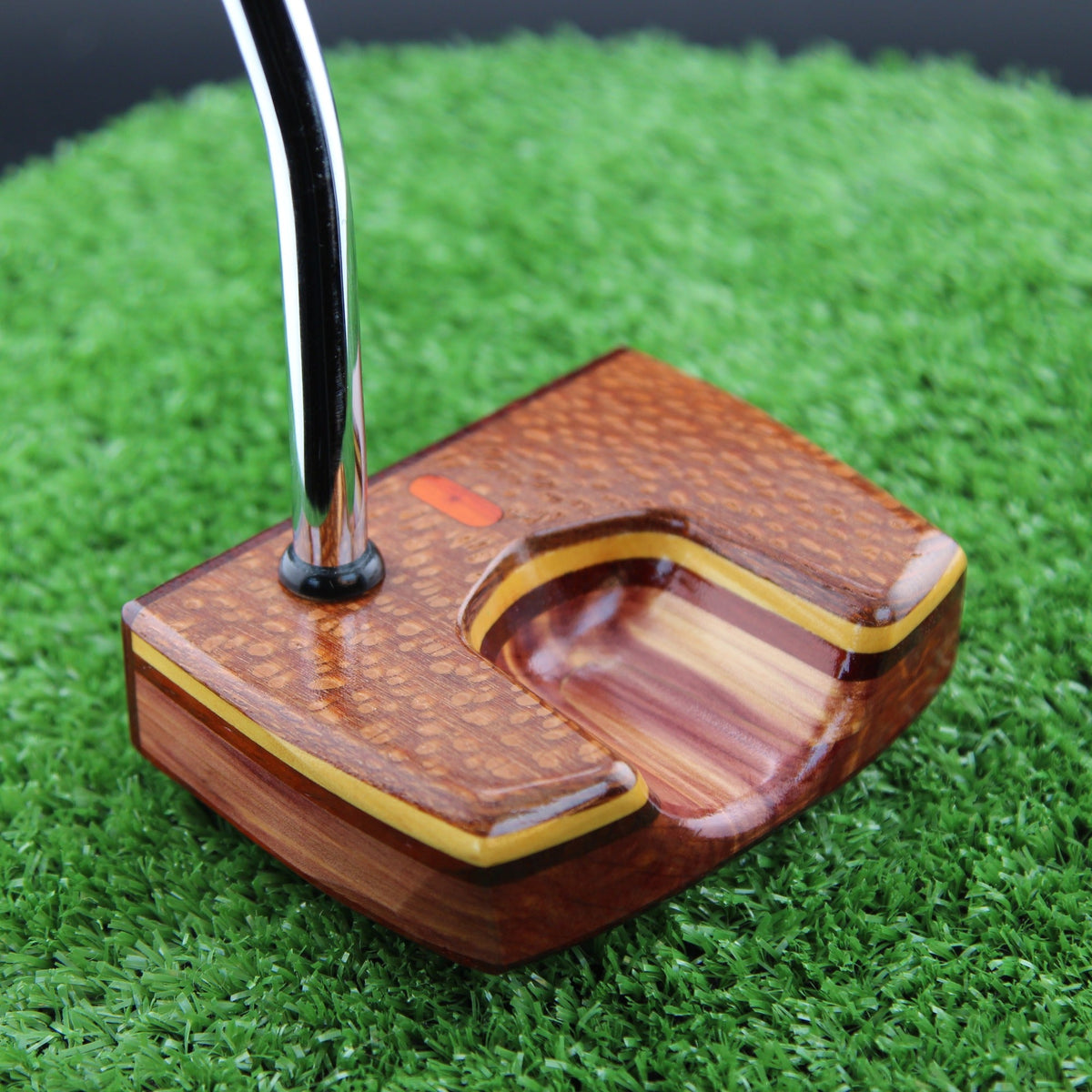
Topaz Woodrich Regal — Canarywood, Zero Torque
$330 — center shaft, streaked golden Canarywood face
CNC-machined to exact tolerances, hand-finished in the shop — and ready for your custom engraving on the top and sole (+$40 at checkout).
Design Yours → Add to CartWhat a Putting Grip Style Actually Controls
Every grip is a decision about the wrists. In a full swing you want them to hinge. In a putt you mostly want them still, so the shoulders rock the putter and the face stays square through the ball. The reason so many grip styles exist is that different hands misbehave in different ways: some golfers flip the trailing wrist, some rotate the lead wrist open, some just grip so hard the whole stroke gets jerky.
So the question isn't "which putting grip is best." It's "which hand is causing the miss, and which grip takes it out of the stroke." Read the descriptions below with that in mind. (Instructions are written for a right-handed golfer; lefties, mirror them.)
The Main Putting Grip Styles
Conventional (Reverse Overlap)
Left hand on top, right hand below, with the left index finger laid across the fingers of the right hand instead of tucked underneath. It's the grip most golfers start with because it feels like every other club, and it's still the most common grip on tour (Source: SuperStroke).
Who it suits: golfers whose hands already behave. If your misses are read or speed, not a twitch, there's no reason to leave it. Watch for: the right hand taking over on short putts, which shows up as pulls.
Left-Hand Low (Cross-Handed)
Swap the hands: right hand on top, left hand below. The lead wrist ends up flatter and lower, and it's much harder for it to break down through impact. Shoulders naturally level out, which helps golfers who set up with the lead shoulder too high.
Who it suits: anyone who flips or "scoops" at the ball, and anyone whose putts start left of the line. Watch for: a loss of feel on long lag putts, because the dominant hand is now the one doing the least.
Claw (and Its Cousins: Saw, Pencil)
Left hand stays conventional. The right hand comes off the top of the grip and holds it from the side, between thumb and index finger, with the palm facing the body. The right hand can now only push; it can't twist. Variations change how many fingers touch the grip (the "saw" lays the fingers across the top; the "pencil" pinches with two), but the idea is the same.
Who it suits: golfers with an overactive right hand, and anyone fighting a short-putt yip. It's also the grip we see most often paired with a center-shaft, zero-torque head, and the two make sense together: the head has no urge to rotate, and the grip removes the hand that would rotate it. Watch for: it takes a few rounds to trust distance control from long range.
Prayer (Palms Facing)
Both hands on the grip at the same height, palms flat against each other on opposite sides of the handle, thumbs down the front. Neither hand is above the other, so neither one is in charge. Works best with a wide, flat-fronted grip.
Who it suits: golfers who want the most neutral hands possible and are willing to feel a little "arms only." Watch for: a tendency to get too stiff; the stroke needs some rhythm from the shoulders.
Arm Lock
A conventional grip, but the handle runs up the inside of the lead forearm and rests against it, with the hands well forward. It requires a longer putter, usually with more loft to offset the forward press. Because the club touches the forearm rather than being anchored to the body, it's legal under the Rules of Golf.
Who it suits: golfers who want the lead wrist locked completely out of the stroke and don't mind a specialty build. Watch for: it's not a grip you can try with a standard-length putter; the length and loft have to be built for it.
Broomstick and Face-On
These aren't hand grips so much as whole methods, and they change the putter more than anything above. If you're curious, we covered both in Broomstick and Face-On Putting: Who They Help and How to Get Fit, including the anchoring rule.
Matching Putting Grip Styles to Your Miss
| Your miss | Try first | Then |
|---|---|---|
| Pulls on short putts | Claw | Left-hand low |
| Pushes / face opens | Left-hand low | Prayer |
| Flipping, ball hops off the face | Left-hand low | Arm lock |
| Yips inside six feet | Claw | Broomstick or face-on |
| Poor lag distance | Conventional | Lighter grip pressure, not a new grip |
One rule for all of them: change one thing at a time, give it three or four rounds, and judge by results inside ten feet before you judge anything else.
How Grip Choice Meets Putter Design
Three things on the putter itself change how a grip works, and we fit all of them in the shop.
Head design. A center-shaft, zero-torque head like the Topaz or the Espresso doesn't want to open or close on its own, which flatters neutral-hand grips: claw, prayer, left-hand low. A side-shaft head with some toe hang rewards a conventional grip and a slight arc. If you switch grips and the head suddenly feels wrong, that's often why.
Grip shape and size. A claw or prayer grip is easier on a wider, flat-fronted handle; the right hand needs a surface to rest on. Our Premium 2.0 wood-and-leather-look grip can be fitted to any putter we build; if you claw, tell us and we'll make sure the shape suits it.
Length and loft. Left-hand low and claw both tend to move the hands slightly forward, delofting the face. If you switch grips and the ball starts hopping, a half-degree to a degree more loft usually fixes it. Tell us your grip when you order and we'll take it into account when we set the head up.
From the Shop
Pick Your Putter — Every One Can Be Engraved


Add custom engraving to any putter for $40 — just select the option on the product page.
Putting Grip FAQ
What is the best putting grip?
There isn't one. The conventional reverse overlap is the most common, but the best putting grip is the one that quiets the hand causing your miss: claw for an overactive right hand, left-hand low for a breaking-down lead wrist, prayer for fully neutral hands. Test each for a few rounds and keep the one that holes more inside ten feet.
Is the claw grip good for the yips?
It's the most common first fix, because it stops the right hand from twisting the face. If the claw doesn't settle things, broomstick or face-on putting takes the hands out of the stroke even further.
Why do pros putt left-hand low?
It flattens the lead wrist and levels the shoulders, which keeps the face square through impact. It gives up a little feel on long putts in exchange for consistency on short ones.
Do I need a special putter for the claw?
No, but a wider, flat-fronted grip helps the right hand rest comfortably, and a center-shaft zero-torque head suits the neutral-hands stroke the claw produces.
Is the arm lock grip legal?
Yes. The rules prohibit anchoring the club to the body; the arm lock rests the grip against the forearm, which is allowed. It does require a longer putter with more loft.
Picking Your Grip
Start with the miss, not the fashion. Pulls and yips point to the claw; flips and pushes point to left-hand low; if none of that describes you, stay conventional and work on speed. Then tell us which grip you've landed on when you order, and we'll build the loft, length, and handle to match it. The putter should fit the way you hold it, not the other way around.
Make Your Mark on the Green
Every TimberTouch putter is designed in CAD, CNC-machined to exact tolerances, and hand-finished. Tell us your grip, pick your woods, and we'll engrave your story into it.
Shop All Putters →First Look at New One-of-a-Kind Builds
Many of our putters are one of a kind — when they're gone, they're gone. Join the list and see new builds and engraving ideas before anyone else.
Share:
Black Limba Putters: The Guitar Maker's Wood That Belongs on the Green
How the First Wood Golf Clubs Were Made: A Modern Maker Looks Back