

Here's a question most golfers never think to ask: why do golf balls have dimples at all? Every other ball in sports is smooth. Yet a golf ball wears 300 to 500 little craters, and they aren't decoration — they're the single most important aerodynamic feature in the game. Hit a perfectly smooth golf ball with a pro's driver swing and it would travel roughly half as far as the dimpled one. And the way golf discovered this is a craftsman's story: nobody calculated it — players noticed their old, battered handmade balls flew better than their new ones. We can't resist a story where the workshop beat the theory to the answer.

Signature Design · The Obsidian Grain
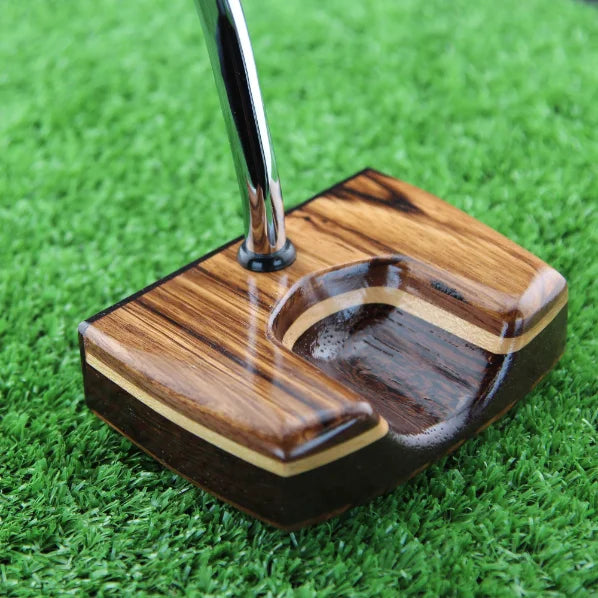
Zebrawood Zero Torque Woodrich Regal
$310 — physics-first design in striped Zebrawood
CNC-machined to exact tolerances, hand-finished in our shop — and ready for your custom engraving on the top and sole (+$40 at checkout).
Design Yours → Add to CartThe accidental discovery: battered beats new
In the mid-1800s, golf balls were smooth spheres of molded gutta-percha sap — the "guttie." Players kept noticing something that made no sense: a fresh, perfect guttie flew poorly, while an old one covered in nicks, cuts, and hammer marks sailed. So ball makers stopped fighting it. They began hand-hammering patterns into new balls on purpose, then molding raised brambles, and by the early 1900s the recessed dimple was patented and took over. The aerodynamics textbooks explaining why came decades later. The battered ball was the experiment; the workshop ran it first.
The physics: why rough beats smooth
It seems backwards — shouldn't a smooth ball slip through the air more easily? For a golf ball at golf-ball speeds, no, and the reason is the wake it drags behind it.
Air flowing around a smooth sphere hugs the surface in a thin "boundary layer" that peels away early, leaving a big, low-pressure wake behind the ball — and that pressure difference is drag, constantly pulling the ball backward. Dimples deliberately trip the boundary layer into a thin blanket of turbulent, churning air. Counterintuitively, that energized turbulent layer clings to the ball's surface longer, following its curve farther around the back before separating. The wake shrinks dramatically — and with it, the drag drops to roughly half that of a smooth ball. (Source: Scientific American)
The second job dimples do is lift. Every good strike puts backspin on the ball, and a spinning ball drags its boundary layer with it — air moves faster over the top than underneath, pressure drops above the ball, and the ball gets pushed upward. That's the Magnus effect, and dimples amplify it enormously. A well-struck drive isn't just thrown by the club; it's genuinely flying, with lift supporting a large share of its hang time.
Put both together and the numbers get dramatic: a professional drive that carries around 270 yards with a dimpled ball would manage only about 130–140 with a smooth one — half the distance, on a low, dying trajectory. (Source: Scientific American)
Why 300 to 500 dimples, and why they differ
Most modern balls carry between 300 and 500 dimples — 336 is a classic count — arranged in patterns designed for symmetry, so the ball behaves the same no matter how it's oriented. Manufacturers tune dimple count, depth, and shape the way we tune wood layers: shallower dimples generally mean higher flight, deeper ones a flatter, more penetrating trajectory. A change of a few thousandths of an inch in dimple depth measurably alters flight — which is a sentence that makes perfect sense to anyone who machines things for a living.
Dimples don't matter on the green — here's what does
All of that physics switches off the moment the ball lands on the putting surface. There's no boundary layer to manage at 6 feet per second — rolling, not flying, is the whole game. What matters on the green is how the ball leaves the face: how quickly it stops skidding and starts rolling true.
That's the part of ball flight we obsess over. Our putters are CAD-designed and CNC-machined from layered exotic hardwoods with the loft and balance to get the ball rolling end-over-end early — our Obsidian Grain, a Zebrawood zero-torque center-shaft design, keeps the face square through impact so the roll starts pure instead of sideways-skidding. The ball's dimples got it to the green; the putter's geometry gets it in the hole.
Common questions
Why do golf balls have dimples?
Dimples trip the air around the ball into a thin turbulent layer that clings to the surface longer, shrinking the drag-producing wake behind the ball, and they amplify the lift created by backspin. Together those effects roughly double how far a golf ball flies compared with a smooth ball.
How far would a smooth golf ball go?
About half as far as a dimpled one — a drive that normally carries 270 yards would come down somewhere around 130–140, on a low trajectory that falls out of the sky. (Source: Scientific American)
How many dimples does a golf ball have?
Most balls have between 300 and 500; 336 is a traditional count. There's no required number — the rules demand symmetry, and makers tune count, depth, and pattern to shape trajectory.
Do dimples affect putting?
Not meaningfully — at putting speeds aerodynamics is irrelevant. What matters on the green is the quality of the roll off the face: loft, face angle, and strike determine how fast the ball stops skidding and starts rolling true.
From the Shop
Pick Your Putter — Every One Can Be Engraved


Add custom engraving to any putter for $40 — just select the option on the product page.
The workshop got there first
Golf's most important aerodynamic breakthrough wasn't computed — it was noticed, by players and ball makers paying attention to what their hands and eyes told them. A century later, the tools are better; we get CAD and CNC instead of a hammer and a hunch. But the method is the same one we practice every day: build it, watch what it actually does, and let the results overrule the assumptions.
Make Your Mark on the Green
Every TimberTouch putter is designed in CAD, CNC-machined to exact tolerances, and hand-finished. Pick yours and we'll engrave your story into it.
Shop All Putters →First Look at New One-of-a-Kind Builds
Many of our putters are one of a kind — when they're gone, they're gone. Join the list and see new builds and engraving ideas before anyone else.
Share:
The Best Golf Gift Isn't a Dozen Balls: Why a Wood Putter Wins
Putter Loft Explained: Why Stated Loft Isn't the Whole Story