

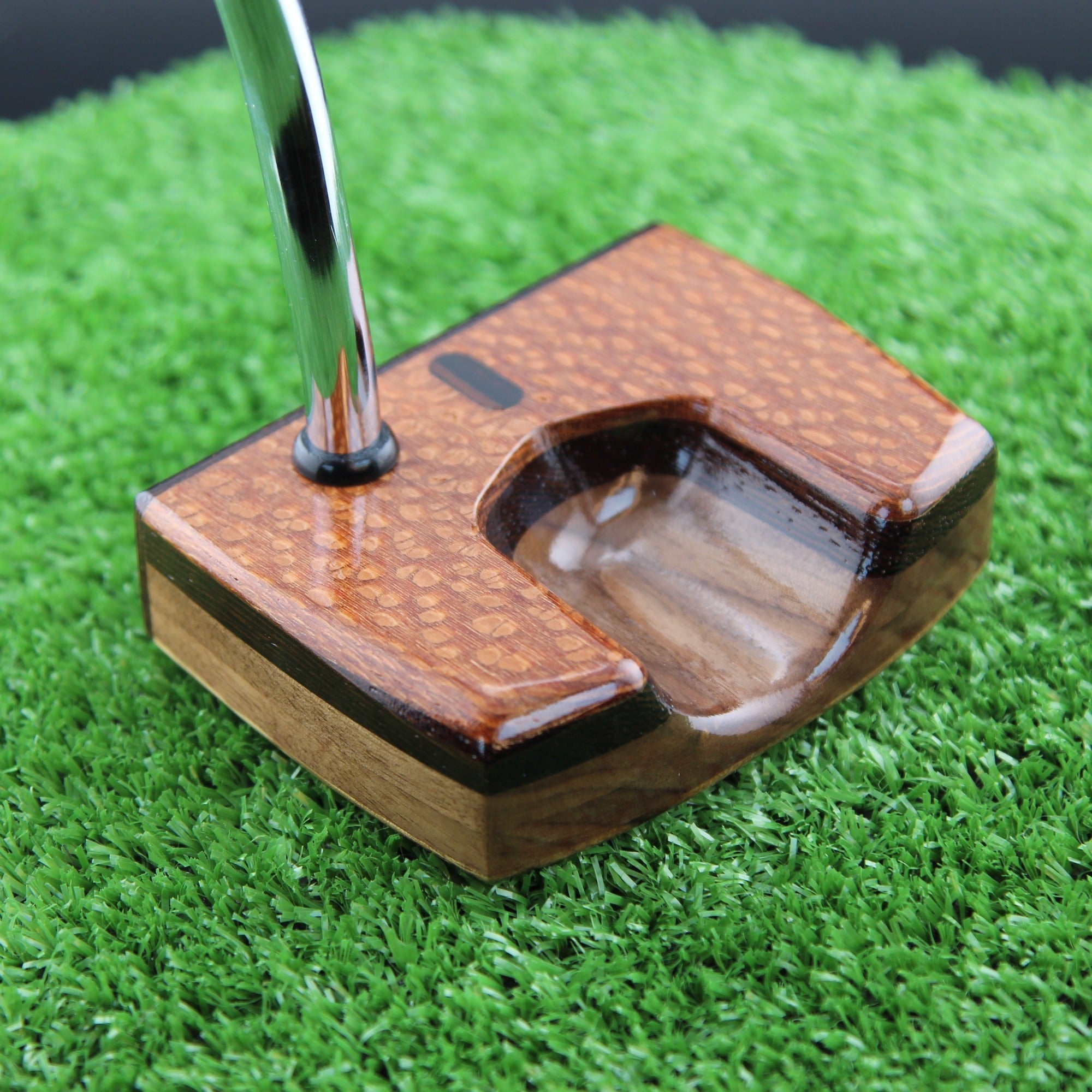
People ask me all the time whether a one-of-a-kind putter is really one of a kind, or whether that's just a nice thing to say on a product page. Fair question. Most "handmade" clubs come off the same jig, in the same shape, with the same materials, over and over. Mine don't, and it isn't a marketing choice. It's what happens when you build a putter out of layered exotic hardwood, one at a time, by hand at the bench.

Signature Design · The Savanna
Savanna — Zebrawood & Tigerwood FATTY Mallet
$305 — African grain no two boards repeat
CNC-machined to exact tolerances, hand-finished in the shop — and ready for your custom engraving on the top and sole (+$40 at checkout).
Design Yours → Add to CartHere's the honest version of what "one of a kind" actually means when the head is wood, why no two ever come out the same, and what that's worth to you when you're deciding whether to buy one.
What "one-of-a-kind" actually means in a wood putter
A steel putter is poured or milled from one uniform material. Every billet of 303 stainless is essentially identical to the next, so a run of 500 heads can be genuinely interchangeable. That's the whole point of a factory: sameness.
Wood is the opposite. Every board I pull off the rack has its own grain direction, its own density, its own figure and color. When I layer Padauk over Wenge, or run a Zebrawood body with a Tigerwood inlay, I'm stacking materials that each behave a little differently. So even two putters of the same model — say, two Woodrich Regals — leave my shop with their own fingerprint. The wood decides part of it, and I decide the rest.
That's why I don't call my putters one-of-a-kind to sound premium. I call them that because I literally cannot make the same one twice.
Why no two exotic wood putters behave the same
Grain is the big one. In a single plank, the grain runs one way here and swirls another way three inches down. That figure is what makes an exotic like Bloodwood or Leopardwood look alive when the light moves across it — and it's unrepeatable. I can cut two blanks side by side from the same board and get two different faces.
Density matters too. Wenge and Ebony are heavy and dense; Cedar and Canarywood are lighter. When I build a layered head, the exact mix of woods in that specific putter sets its raw weight and where the mass sits before I ever add sole weighting. Two putters that look like cousins can start out a few grams apart, which changes the balance in your hands.
Then there's how each wood takes a finish. Denser woods polish to a deeper, wetter shine; open-grained woods drink finish and read warmer. I sand and finish every head by feel until it's right, not until a timer goes off. No two come off the bench identical because I'm reacting to the wood in front of me, not a spec sheet.
The build choices that make each one unique
Beyond the wood itself, every putter carries a stack of choices that never line up the same way twice:
- The layup. Which woods, in what order, how thick each layer sits. An 8-layer Fatty build with Zebrawood, Rosewood, and Wenge is a different animal than a three-wood Woodrich Regal.
- The inlay. A Wenge inlay against Rosewood reads completely different than Canarywood against Bubinga. The placement is done by eye.
- The shape and style. A large center-shaft Fatty mallet, a mid-mallet Regal with its back cavity, a Bladewood — each hangs and balances its own way.
- The engraving. A name, a date, a course, an initial. Once that's cut into the sole, that putter belongs to one person and no one else.
Stack all of that on top of natural grain variation and you can see why "one of a kind" isn't a slogan. It's arithmetic.
What a one-of-a-kind putter means for you as a buyer
The upside is the obvious part: you own a putter no one else on the course has, built from woods chosen for that single club, with real feedback and a soft, honest roll off the wood face. It's a performance tool and a piece you'll keep.
But I'll give you the honest trade-off too, because it matters. If you fall for a specific putter in my shop, that's the one to get — I can build you something in the same spirit, but I can't reproduce that exact grain and character again. When it's gone, it's gone. That's the nature of a real one-off, and it's the opposite of how factory clubs work.
If that appeals to you, the Specialty and One-of-a-Kind Putters collection is where the true one-offs live — the layups and wood combinations I only made once. Browse it the way you'd browse a rack of guitars: find the one that speaks to you, because that particular one won't come around again.
From the Shop
Pick Your Putter — Every One Can Be Engraved


Add custom engraving to any putter for $40 — just select the option on the product page.
Frequently asked questions
Are wooden putters legal under USGA rules?
Yes. The Rules of Golf don't restrict what material a putter head is made from, so a wood putter is conforming as long as it meets the standard dimensional rules — at least 18 inches long, with head width no more than 7 inches and height no more than 2.5 inches (Source: USGA Equipment Rules). Every TimberTouch putter is built to conform.
Can you build me two identical wood putters?
Not truly identical, no. I can build a matched pair in the same model, woods, and length, and they'll look like siblings — but natural grain and density mean each one still has its own character. That uniqueness is the point of a wood putter, not a defect.
How do I care for a one-of-a-kind wood putter?
Treat it like the piece it is: wipe it dry after a wet round, keep it in its headcover between holes, and store it out of extreme heat. That's it. Cared for simply, a well-finished exotic wood putter holds up for the long haul.
Are one-of-a-kind putters worth the price?
If you want a mass-produced gamer, no — buy steel. A one-of-a-kind wood putter is worth it when you value craftsmanship, feel, and owning something no one else has. You're paying for hours of hand work and a club that's genuinely yours.
Find the one that's yours
A one-of-a-kind putter isn't for everyone, and I'd rather you know that going in. But if the idea of a club built from a single set of exotic boards, finished by hand, and impossible to duplicate is the kind of thing that pulls at you — that's exactly what I make, one at a time.
Have a look through the one-of-a-kind builds, or reach out if you want to commission something around a wood or a story that means something to you. I'll help you find the one that feels right in your hands.
Make Your Mark on the Green
Every TimberTouch putter is designed in CAD, CNC-machined to exact tolerances, and hand-finished. Pick yours and we'll engrave your story into it.
Shop All Putters →First Look at New One-of-a-Kind Builds
Many of our putters are one of a kind — when they're gone, they're gone. Join the list and see new builds and engraving ideas before anyone else.
Share:
Walnut Putters: The Quiet Backbone of Every Exotic Wood Build
Broomstick and Face-On Putting: Who They Help and How to Get Fit